Showing posts with label Festive Treats. Show all posts

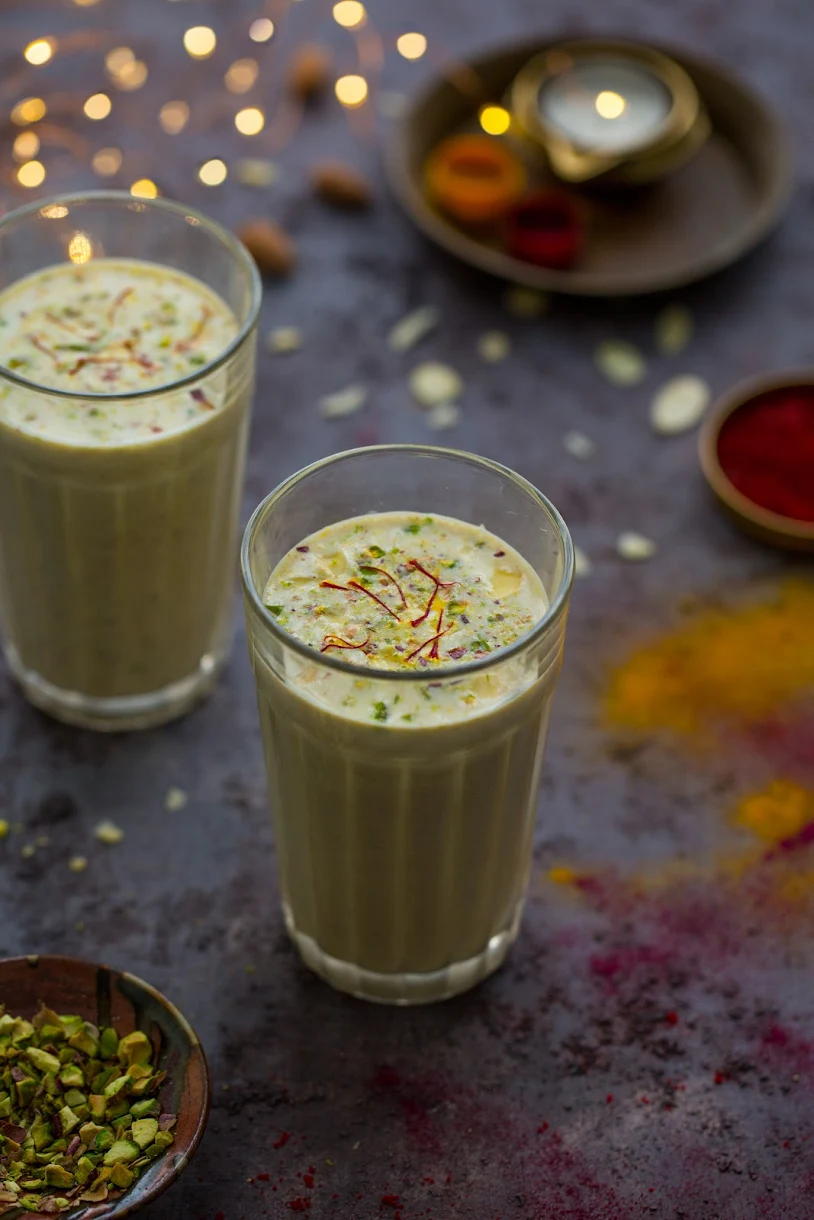
Thandai

How to make Thandai | Easy Thandai Recipe
Holi is just around the corner and I have been dreaming of all the lovely Indian sweets and treats I can make and bring over here to refresh this space. Holi, the Indian festival of colors, marks the end of winter and commencement of spring. No Holi is complete without bright and vibrant colors, balloons bursting with colored water, the lavish thandais, mouthful of gujiyas and some good lyrical Hindi Bollywood numbers to tap your feet to as you get soaked in a concoction of colours.

I stayed away from partaking in this festival for most part of my life. My earliest memories of Holi dates back to the early years spent in Mumbai where the morning of the festival saw friends and neighbors from the colony flocking in the common areas of the building, smeared in psychedelic colors, throwing water baloons and smudging gulal at everyone in sight. Spirits high, air misty and hued, voices high pitched in celebration, it was a frightening sight for an eight year old. As a kid I stayed holed up under my mom's old sewing machine for most part of the day, quite terrified at the sight and sounds of those faces smeared in boisterous colors. It wasn't my kind of celebration.

Years have passed since the little girl who was once petrified of Holi now enjoys the sight of colors. Over years, I've let go my inhibitions and participated in it's celebrations during to my stay here in the US. Miles away from home, the need to connect and bond with Indian community is strong and comforting. Indian festivals give that opportunity. People, food and celebrations bring joy and positivity.

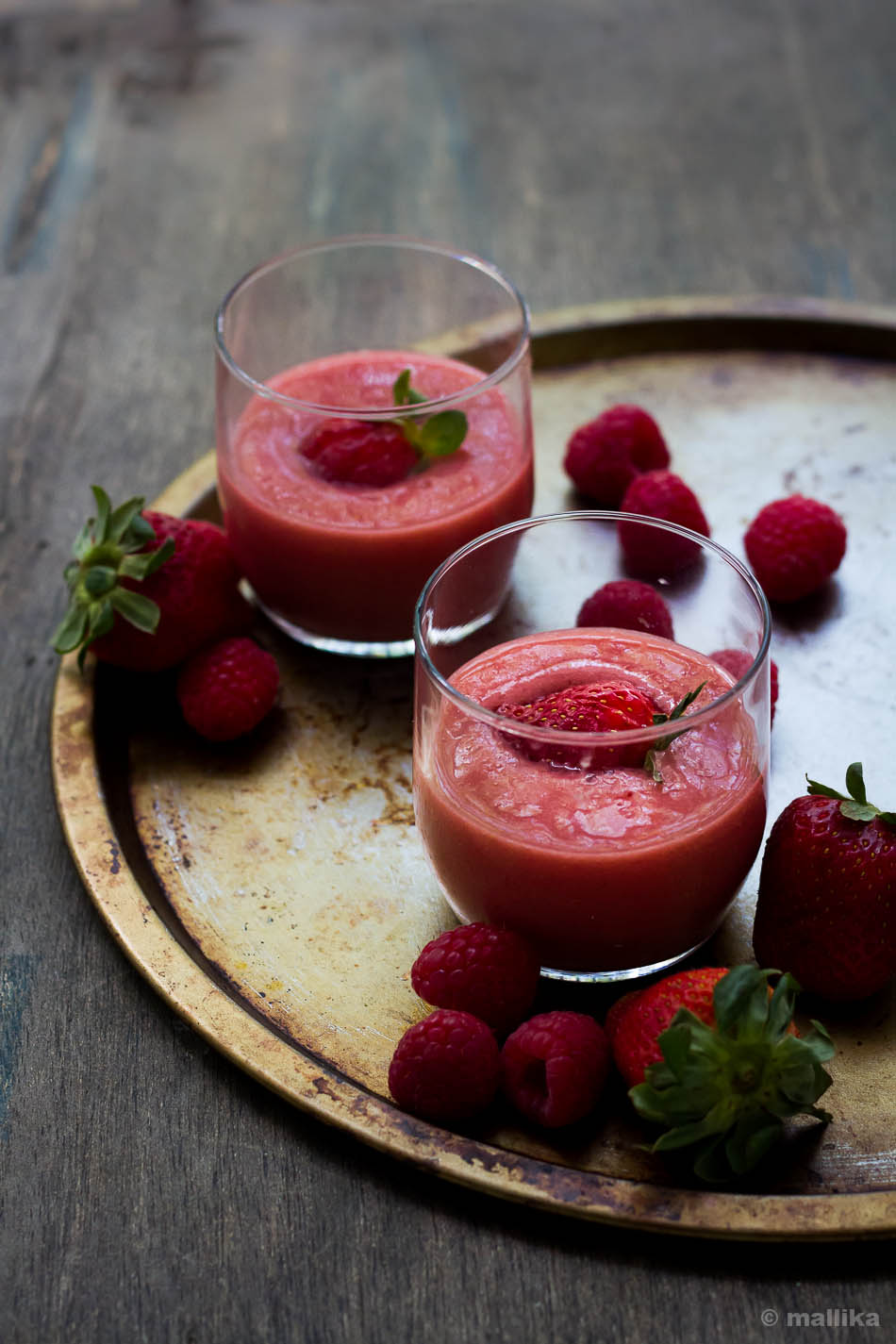
Sumptuous food and drinks is an integral part of Holi celebrations. No Holi is complete without a tall glass of Thandai, the fragrant spiced milk drink, made with amalgamation of ingredients like milk, saffron, nuts and spices. Come on over and let's make some soul-satiating drink that is delicious, cooling and an excellent thirst-quencher.
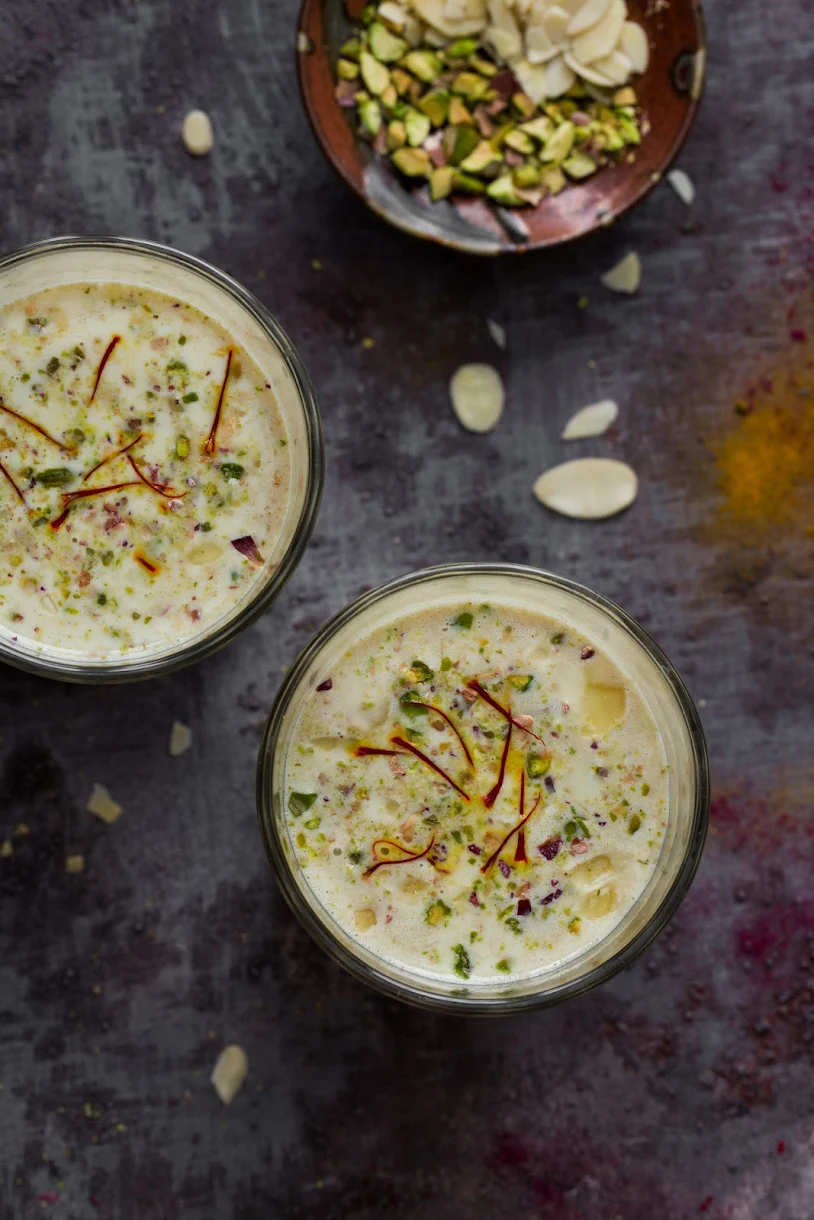
Thandai


Thandai

INGREDIENTS

1 tablespoon fennel seeds
1 tablespoon poppy seeds
1 tablespoon melon seeds (optional)
1 teaspoon peppercorns
Pods from 6 green cardamoms
10 almonds
10 cashews
1/2 teaspoon rose water
1 cup warm water
1 litre milk (replace by soy milk / oat milk / almond milk for vegan version)
Sugar (as per taste)

DIRECTIONS

Soak the fennel seeds, poppy seeds, melon seeds, peppercorns, cardamom pods, almonds and cashewnuts in a cup of warm water for 30 minutes. Then grind the soaked ingredients into a fine paste and keep aside.

In another small bowl, soak the saffron strands in warm milk and set it aside for 30 mins.

Next, in a pan bring milk to boil. Add sugar to your preference, stir well and simmer till the sugar melts in the milk. Add the ground thandai paste to the milk. Mix well and simmer for 2 to 3 minutes. Turn off the heat, add the rose water and let it sit covered till it comes to room temperature. Then refrigerate it to chill for atleast 2 to 3 hours or preferably overnight. Garnish with some crushed rose petals, saffron strands and chopped almonds and pistachios. Serve chilled!

Note: I mention melon seeds as optional since they are not easily available where I stay. However traditionally Thandai uses melon seeds. Though it doesn't affect the flavor much incase you skip it.
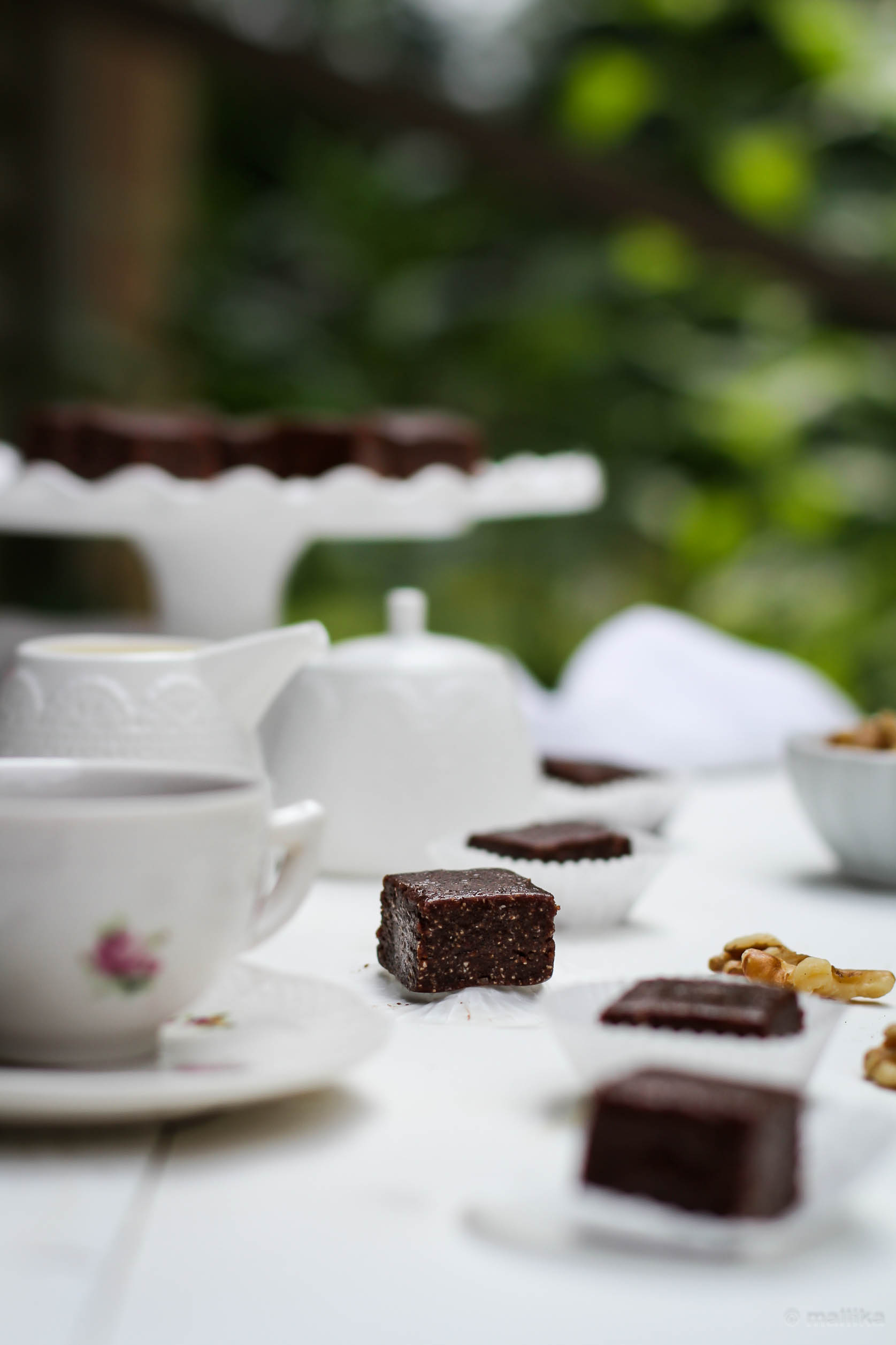
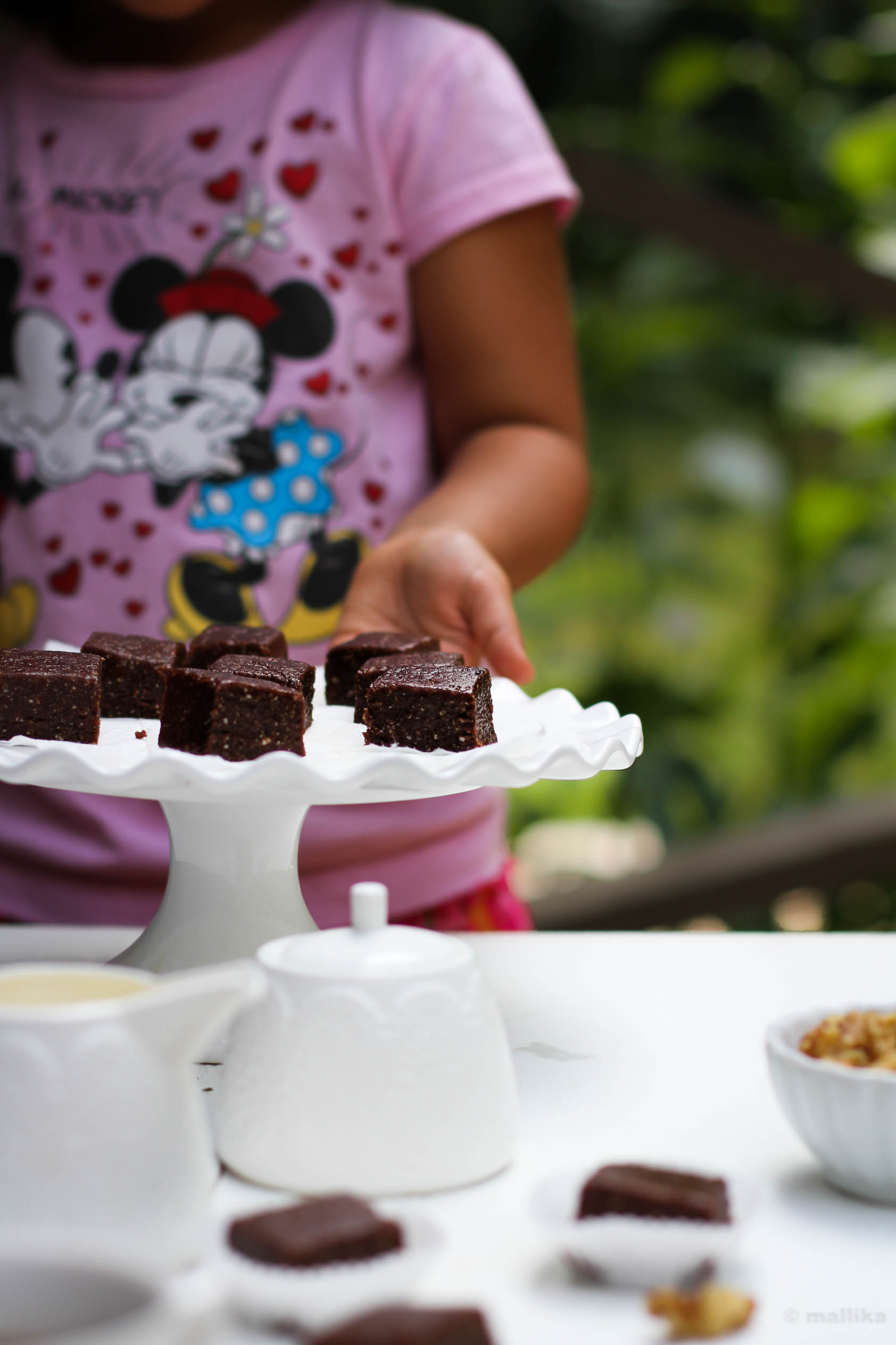
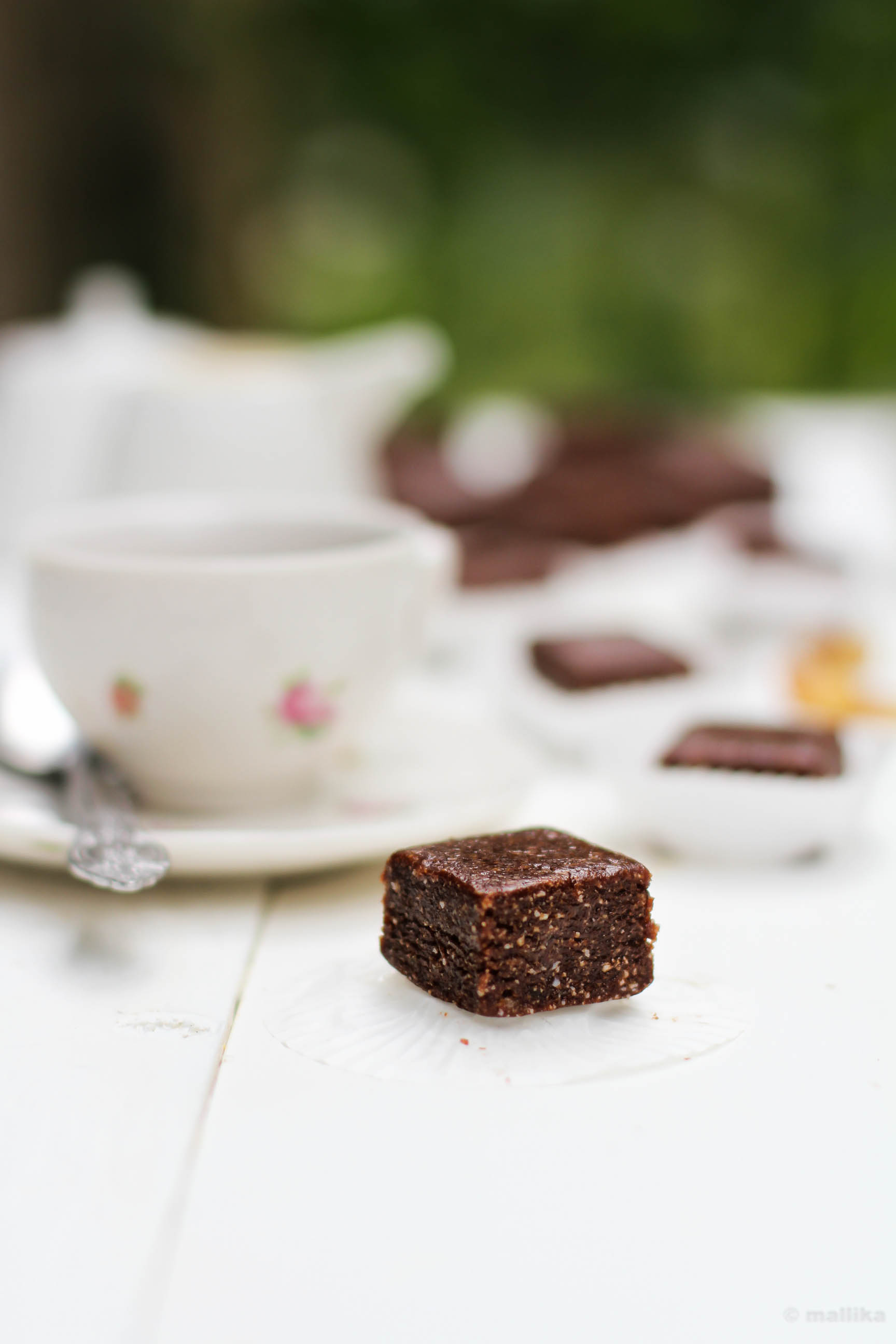
How to make Healthy Raw Brownies | Easy Raw Brownie Recipe
Be thankful for what you have; you'll end up having more. If you concentrate on what you don't have, you will never, ever have enough. - Oprah Winfrey

Its Thanksgiving tomorrow and under five weeks, we'll be well into Christmas, my favorite time of the year when all else goes still and only food and festivities shall prevail. I am excited and am so looking forward to it. As for now, there isn't a grand event of celebration lined up for tomorrow, but, we'll take joy in the holiday to follow, time for togetherness and bonding over relaxed morning, lazying noon and a slow evening. Hurray to no work, no deadlines, no meetings for a day. We'll wake up late in the bed, follow a laid back routine and lavish a little on a good homemade breakfast. The day calls for my time in kitchen, where get to I play with pots and pans, may be tossing up some flour, butter and sugary goodness into a ton of fruits to come up with something worthy for Christmas. A cake is in store, a Christmas fruit cake that I can hopefully talk about in posts to come. We'll have our family at the table, the three of us, savoring lunch in an austere way, which in itself is a small celebration to do on a weekday - bringing in tit-bits of our weekend-ness, in a little modish way.


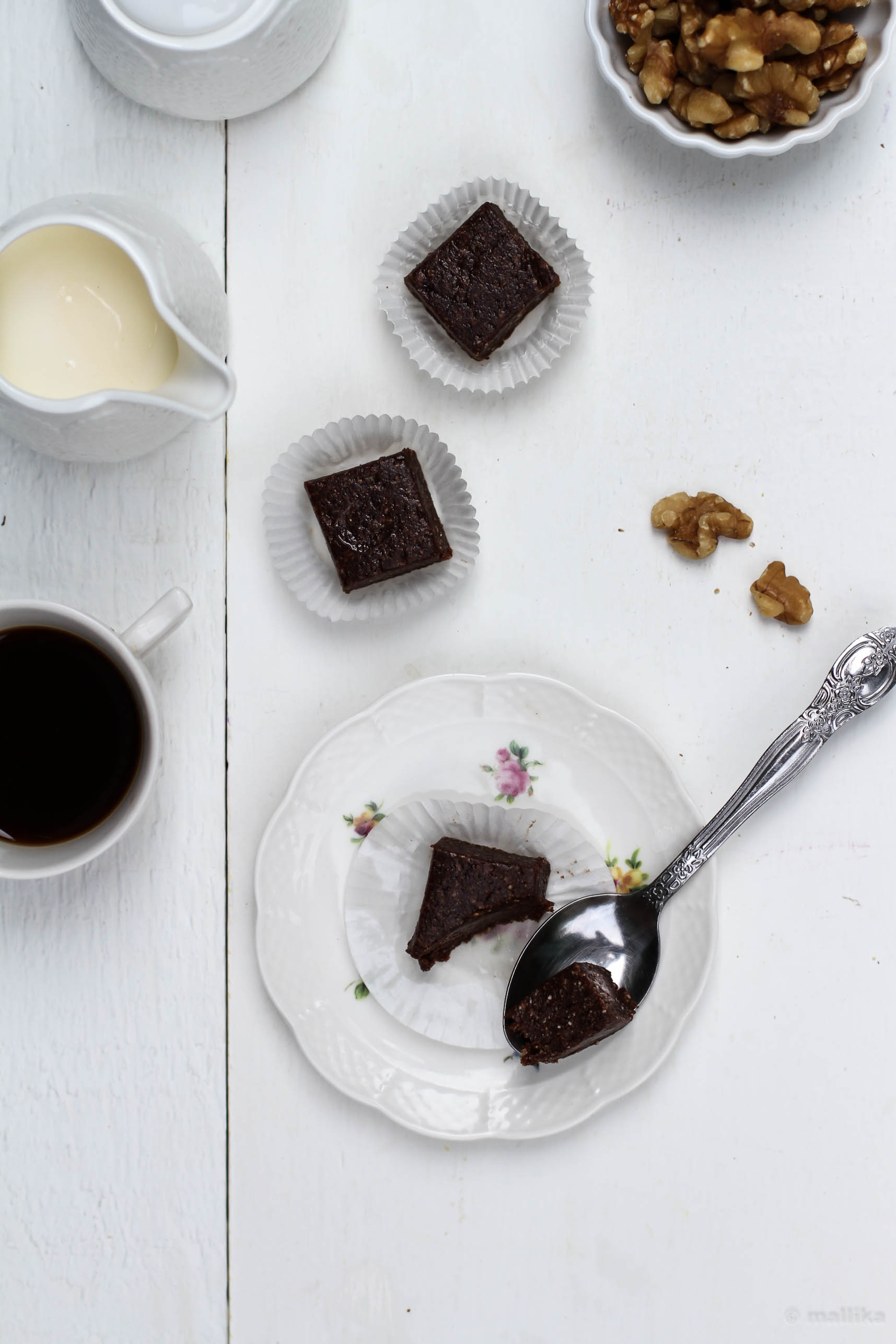
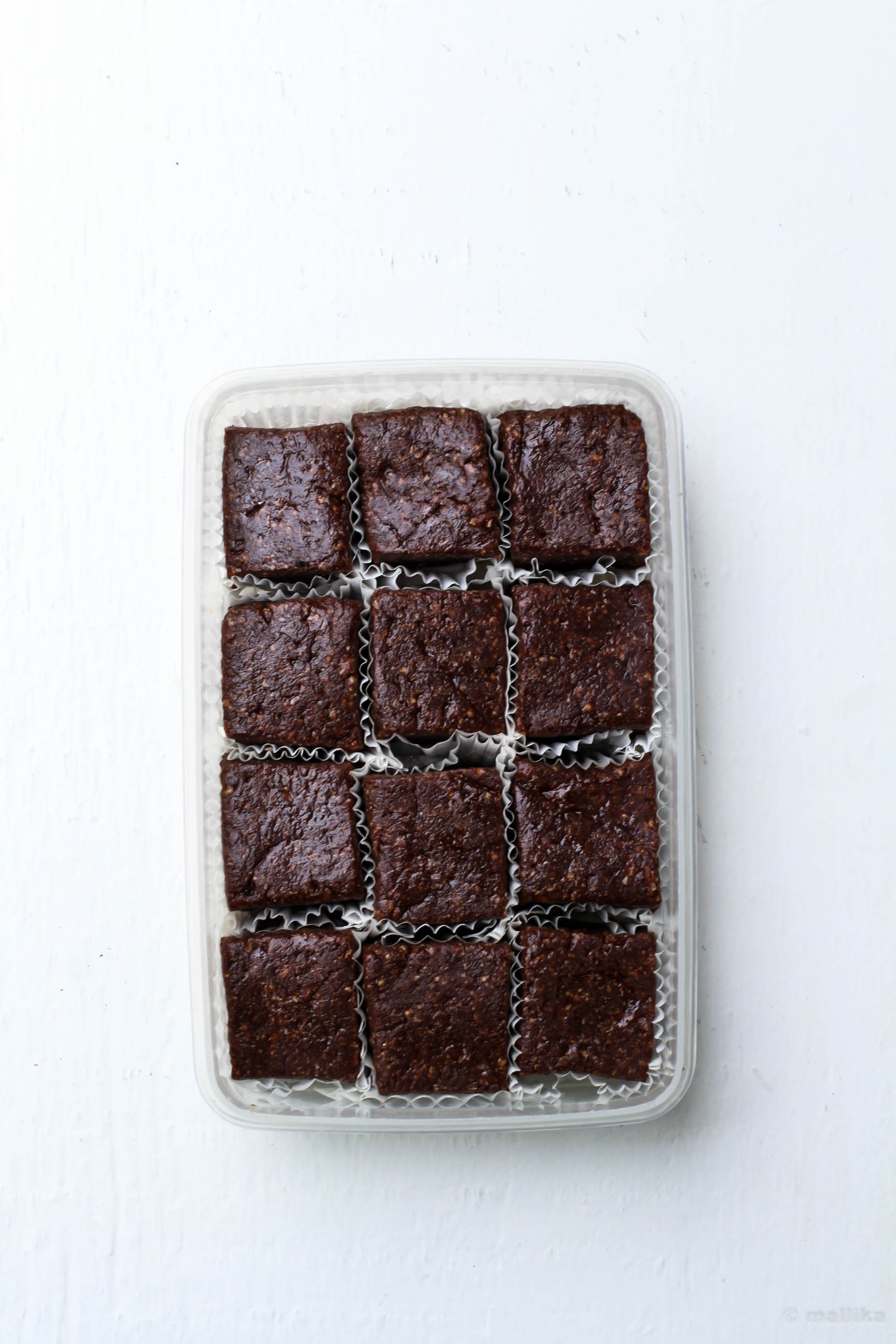
Meanwhile, I have these super healthy brownie treats for you to feature on your Thanksgiving table. I made them this summer, though they don't pertain to any seasons. They are treats you can make year round. No seasons attached. You can make them for your Thanksgiving dessert menu or keep them handy to treat your guests over a cup of coffee or just carry them on your hiking trip to give you adrenaline boost. There's no sugar in them, no butter whatsoever, no flour, no guilt too. And no no! I am not on diet if you ask so. But I thought I should be a little considerate and save you from splurging way too much before the year end celebrations kick in. There's a lot awaiting there, Christmas on its way, New Year dinner to follow, so you may want to treat yourself slowly and sanely before getting there. These little treats don't steal away the joy of splurging, mind you. They are delicious as is in small bites or you can make them in a wonderful no-bake pie base with fancy toppings. Hope these make your Thanksgiving table a little more glamorous.


Raw Brownies

Prep Time: 5 mins | Pulse Time: 10 mins + 2 hrs refrigeration | Yield: 12 pieces

INGREDIENTS

2 cups of medjool dates
1/2 cup of roasted almonds
1/2 cup of raw walnuts
3 tablespoons of raw cacao powder
2 tablespoons of maple syrup

DIRECTIONS

Blend the almonds and walnuts in a food processor until they form a crumbly mixture. Then add the dates and blend again till dates are pureed. Next add the cacao and maple syrup and blend again. The mixture will come together in form of a dough. If its wet to handle, add in some walnuts and pulse again.

Place the mixture into a baking tray. Refrigerate for two hours or freeze for one hour so that it sets well. Cut into slices and serve. Store in an air tight container and keep them refridgerated for freshness.


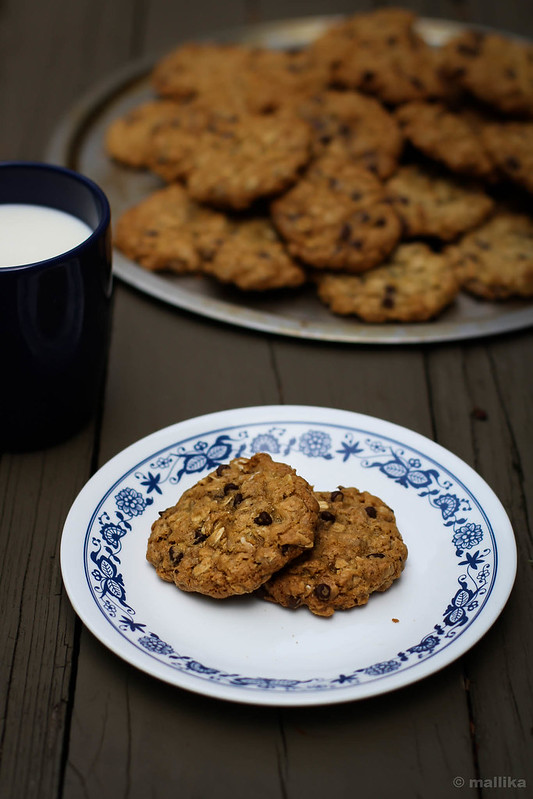
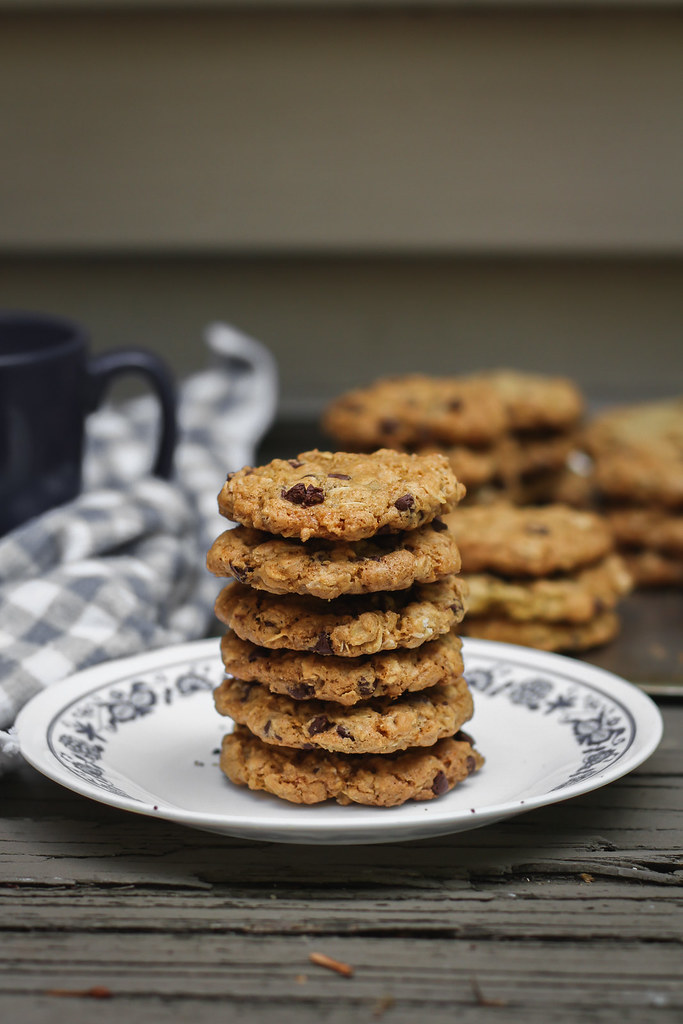
Oatmeal Chocolate Chip Cookies

Oatmeal Chocolate Chip Cookies | Easy Oatmeal Chocolate Chip Cookies Recipe
In our direct sight, right outside our balcony are two young, strong maple trees that stand next to each other in a row. They are probably the last of few trees in our region to hold on to their deepest summer greens, while across the street, the one that we take to drop our daughter to the school bus stop, the towering maples have turned into fiery red, fancy yellows, even burnt browns, scattering themselves on sidewalks and spilling over streets in favor of the autumn's climax that we saw a week ago. The leaves trodden path smell of gentle rot, casting that sweet autumn perfume in air, as many wear their bare-dare look and poke their woody nibs high into the murky skies.

By the time the first streak of sun rays hit our home, we are wide awake, our hair strewn, usually done with brushing and sipping a cup of hot ginger tea for the two. We are at a point when we begin nudging our daughter out of her sleep. That takes us a two-man effort to canoodle, our attempts to wake her up over several minutes - the husband and I, at times her dear grandma adds in too, to pull her off the bed and tow her to the bathroom to start her day with. By this moment there's enough light curtailing the darkness of dawn, and the two maple trees outside our home are well in our sight. We watch it every morning in exhilaration for its transformation, awaiting patiently as it takes its turn to move from greens to yellows, and then to browns. For all the autumn we have seen this season, these two are holding on to their cavernous greens. Did I not say they were strong?

Yesterday, this Saturday morning, voila! The magic unfolded. Leaves changed hues, turning themselves to beautiful golds and bronzes, some earthy greens and blazing reds splashed in random - autumn's treat to us. The curtains stayed open all day long, the doors left ajar despite the chill air, providing us with a better sight and coverage to the trees overall, as we stepped out excitedly to snap a few moments to be treasured. For the next couple of days, the magic shall prevail till they turn matte coppers, sway feebly into air, and pile up in heaps of burgundies and russets on the ground below, before the snow flakes engulf them in uniform of black and white.

IMG_3129 IMG_3130 IMG_3138 IMG_3136 IMG_3129 IMG_3130


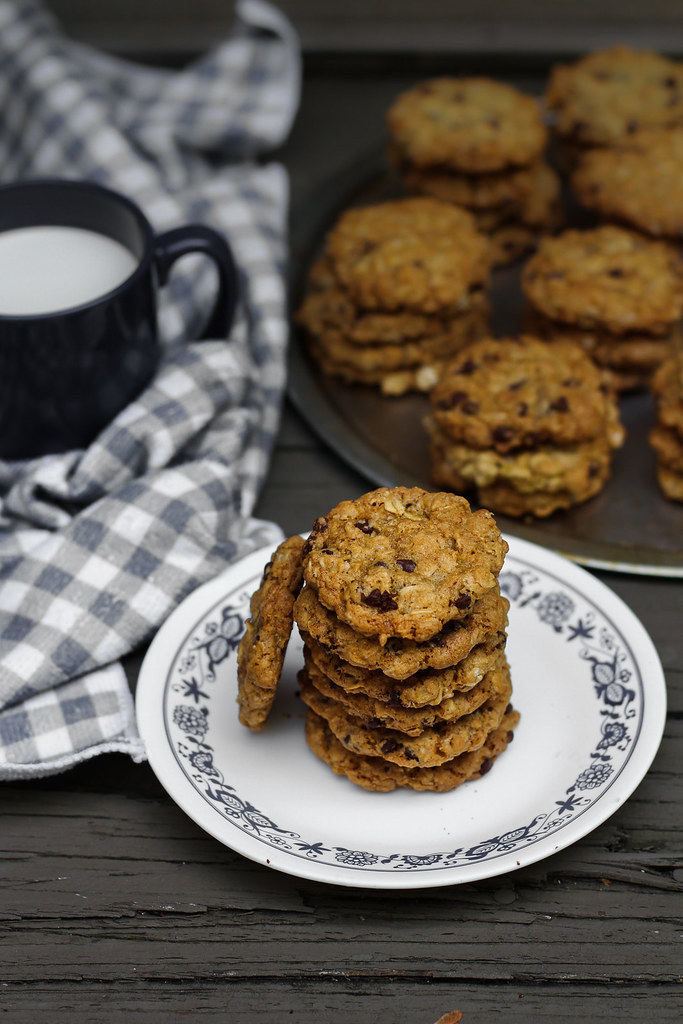
With fall around, there's an awesomeness in air that makes home baking more gratifying. With the year end coming closer, and the holiday spirit in air, desserts will make their prominence on family lunches and dinner gatherings. Oatmeal and Chocolate Chip Cookies are just the perfect things you could bake this season. They'll add more charm to your coffee trays that will roll in as guests visit you. If not, consider them gifting to your loved ones and bring joy to their celebrations.

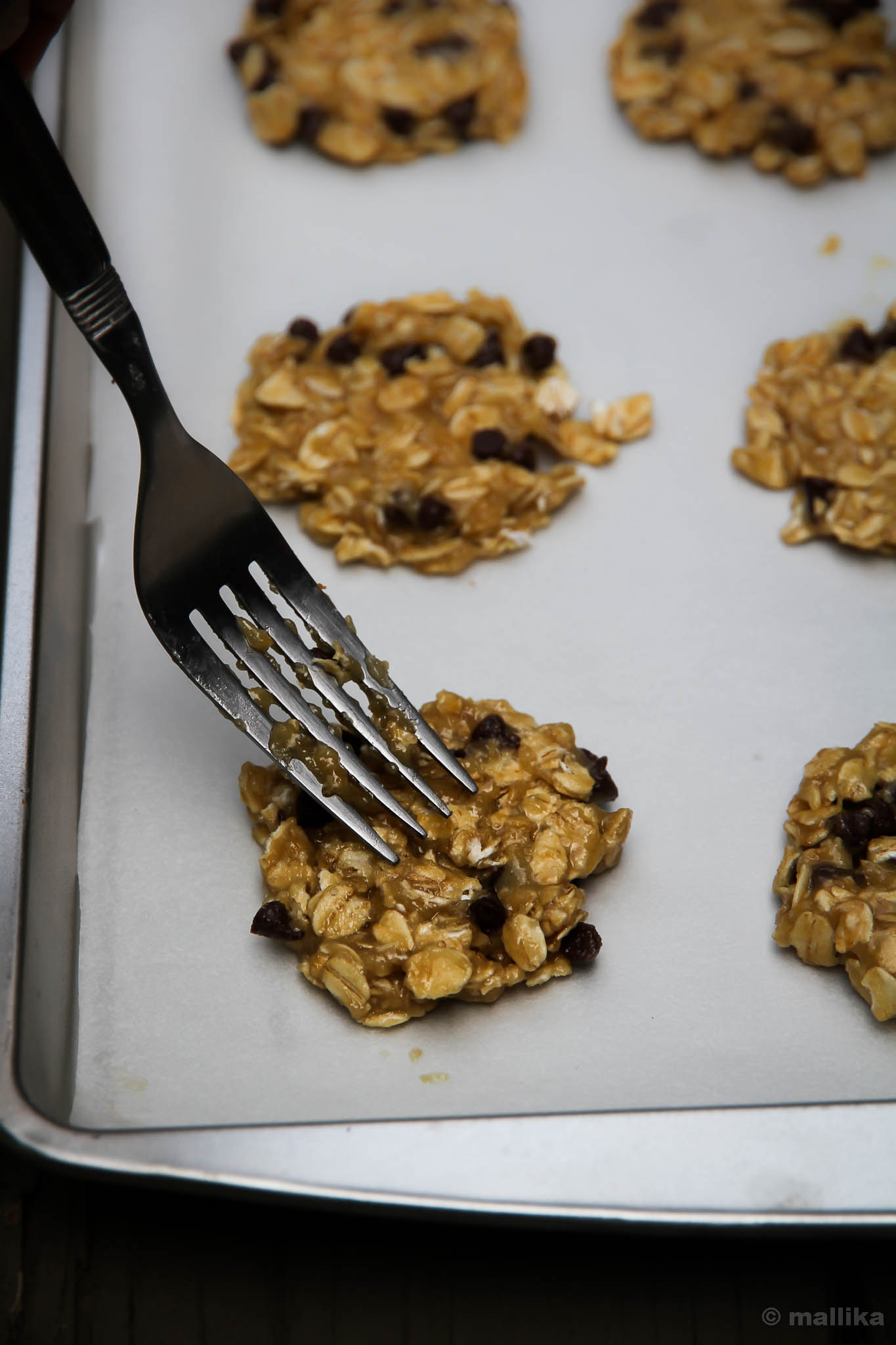
The recipe is adapted from All Recipes. In my quest to find a good recipe for eggless version of Oatmeal Chocolate Chip Cookies, I researched a bit and tried a couple of recipes with varying results. I highly suggest this recipe, albeit minor modifications. I advice you do not cut down on the fat content in this recipe, and balance the brown and white sugars to the below said, that is, if you care for crisp cookies. The cookies do spread a bit, so place them well. We are a family that loves crisp cookies, very Indian in that aspect, so I like to flatten these cookies with a fork before baking. The recipe here will make you a batch of about 16-18 medium sized cookies depending on how much you fill your tablespoon with. If you wish to bring fall to your cookies, add a nice helping of sweet cinnamon and heady nutmeg powder to this recipe. So pull your pans out, warm up your oven and let's bake a batch of these Oatmeal Chocolate Chip Cookies.

Oatmeal Chocolate Chip Cookies

Prep: 10 mins | Cook: 12 min | Makes: 16-18 cookies

INGREDIENTS

1 cup salted butter
1/4 cup packed brown sugar
3/4 cup white sugar
1 teaspoon vanilla extract
1 1/2 cups all-purpose flour
1 teaspoon baking soda
1/4 cup boiling water
2 cups rolled oats
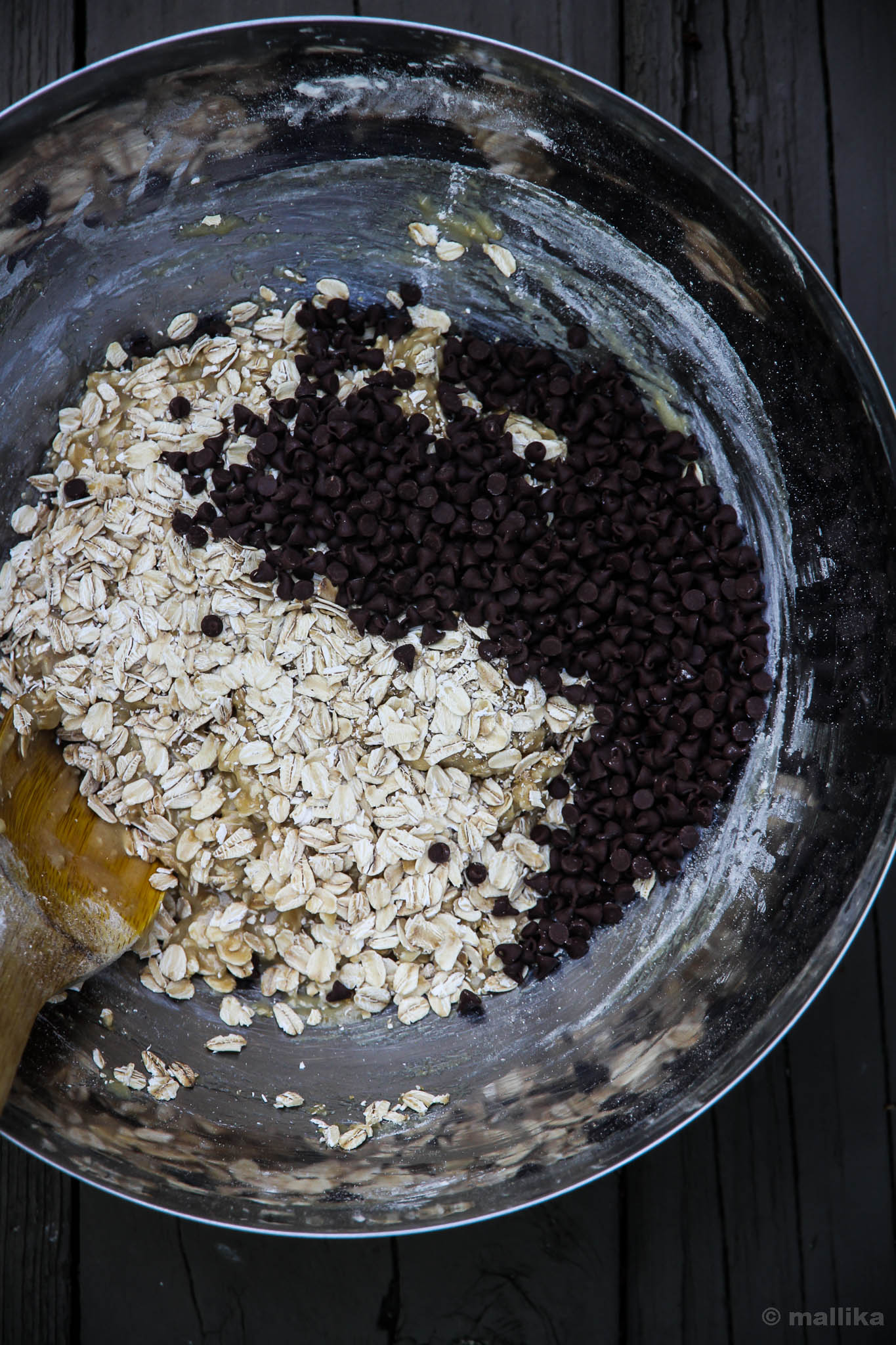
1 1/2 cups semisweet chocolate chips (I used mini chocolate chips)

DIRECTIONS

Pre-heat the oven to 350 degrees F (175 degrees C). Line the cookie tray with baking / parchment paper and set aside.

Bring the butter to room temperature, and beat it with brown sugar and white sugar till its light and fluffy. Add in the vanilla extract and all-purpose flour to this and mix.

Next in a separate bowl, dissolve a teaspoon of baking soda in boiling water. Add this to the above mixture and stir gently.

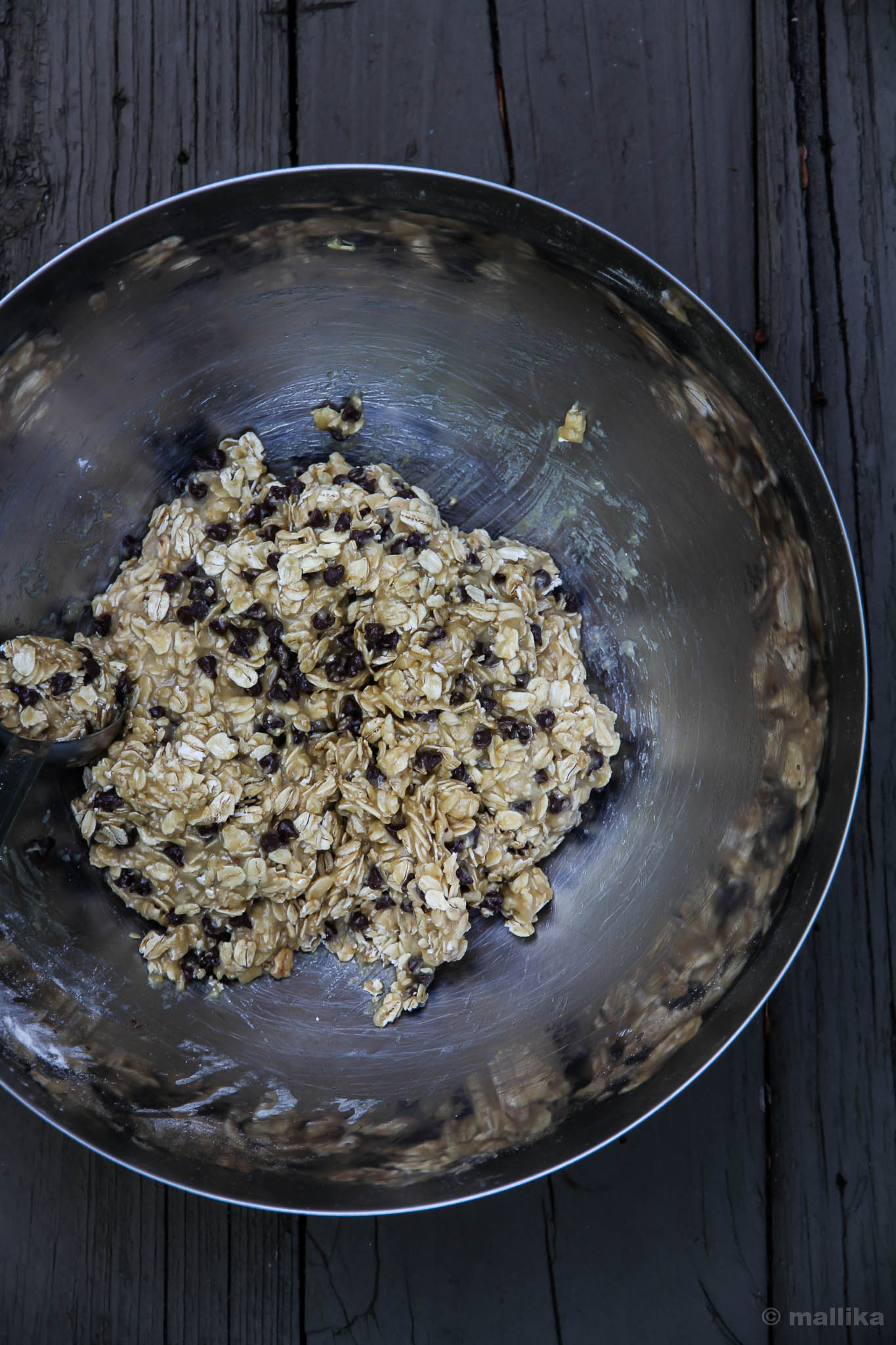
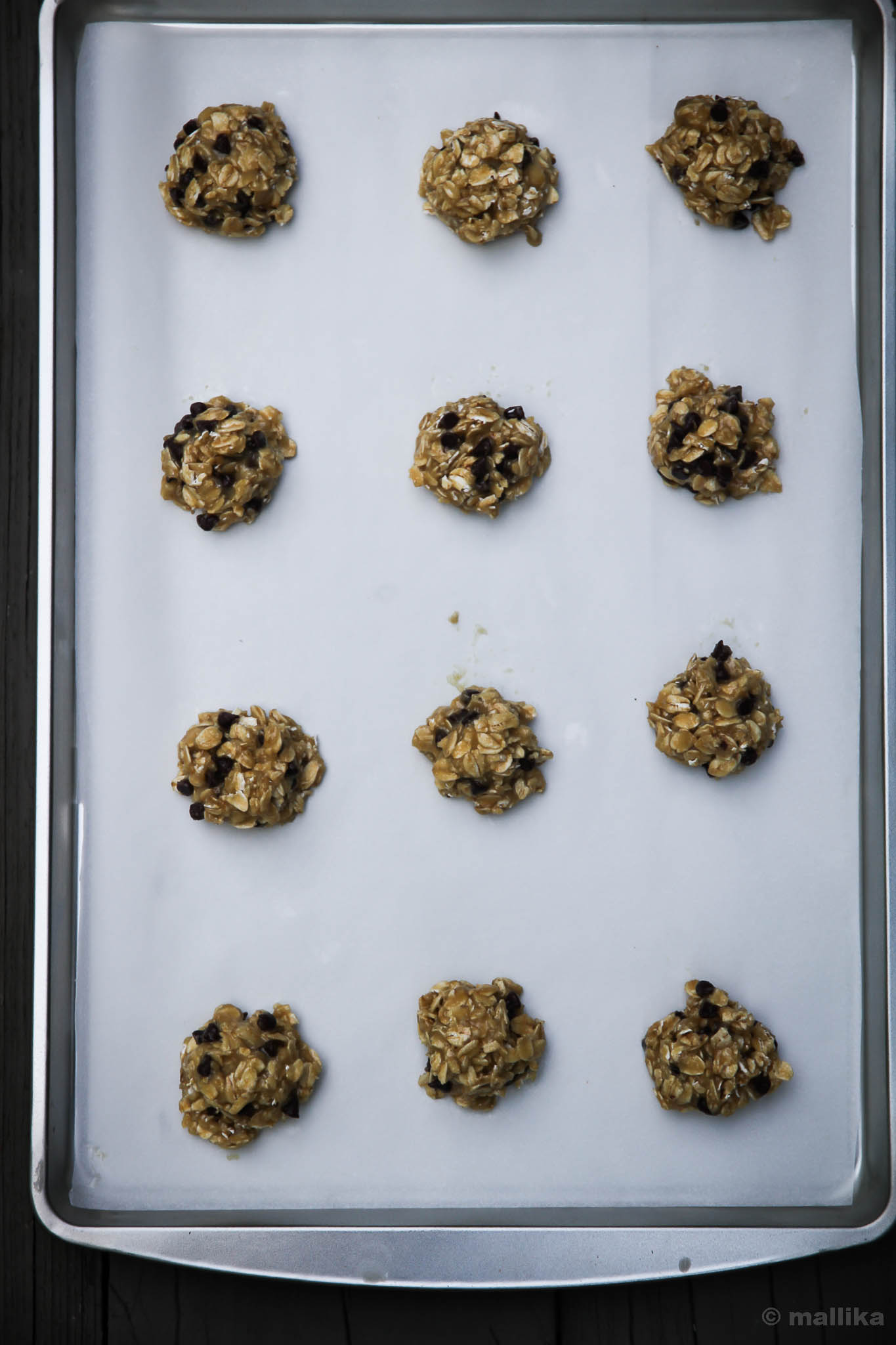
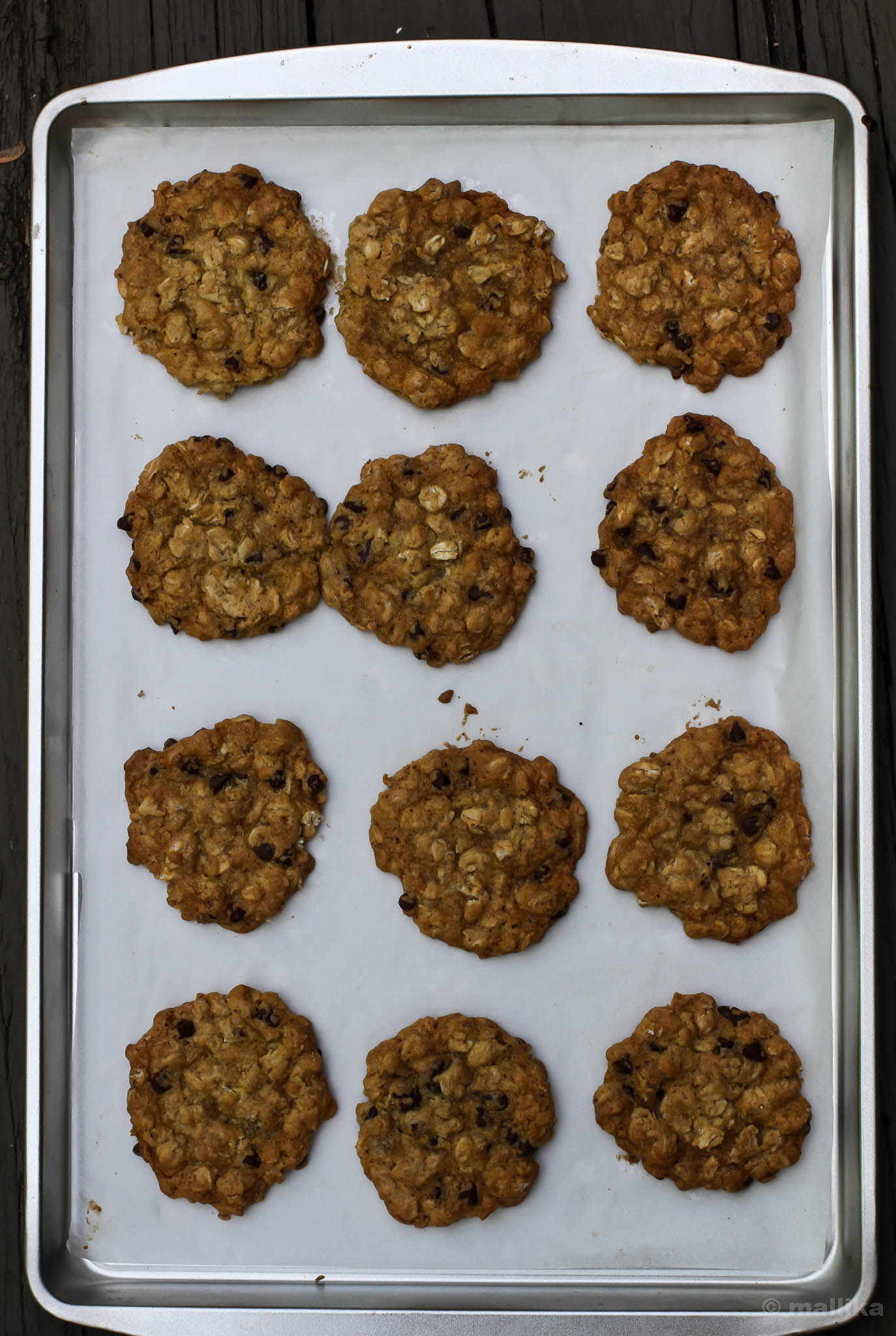
Stir in the rolled oats and raisins and mix them in. Drop by tablespoonful into a tray lined by baking / parchment paper. Bake at 350 degrees F (175 degrees C) for about 10-12 minutes. Don't over bake.

Remove from baking tray and allow them to cool completely on a wire rack. Store them in a air-tight container.

Oatmeal Chocolate Chip Cookies

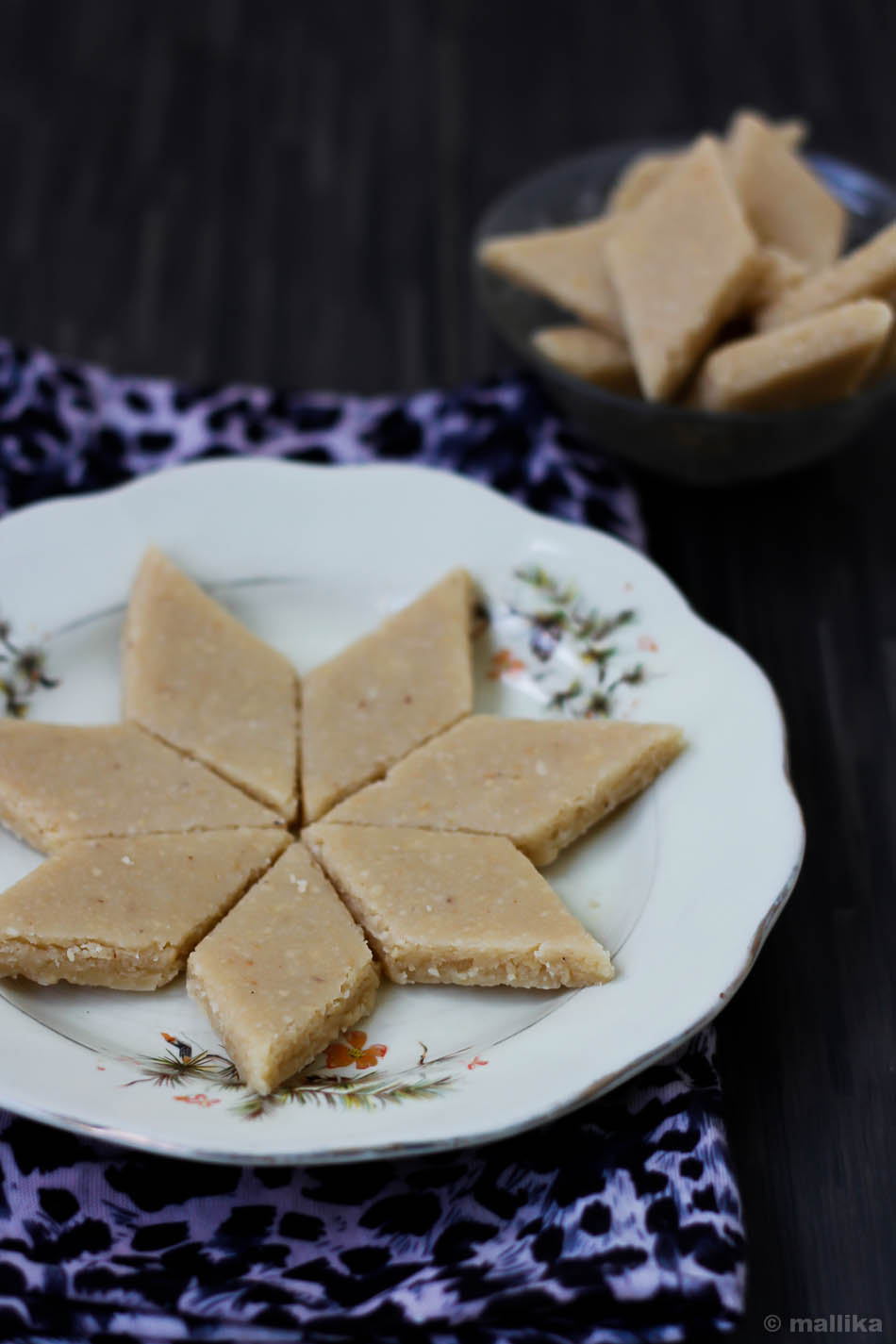
Kaju Katli

How to make Kaju Katli | Cashew Burfi | Cashew Fudge Recipe
Sometime in October last year, just ahead of Diwali, we bumped into my husband's close family friend at a mall one evening. After a brief chat, Mr. S and his wife headed to shop in the mall, while his mom and young daughter hung around us, continuing the talk. My mother and I spent nearly an hour chatting with aunty while the kids were engrossed playing in the ball pit. We spoke at length about the upcoming Diwali preparations, the new dress that aunty had sewn on occasion of Diwali for her grand-daughter, the small disparities in our cultures and the celebrations (they being Tamilans), sharing our favorite family recipes that made the festive celebrations more special.
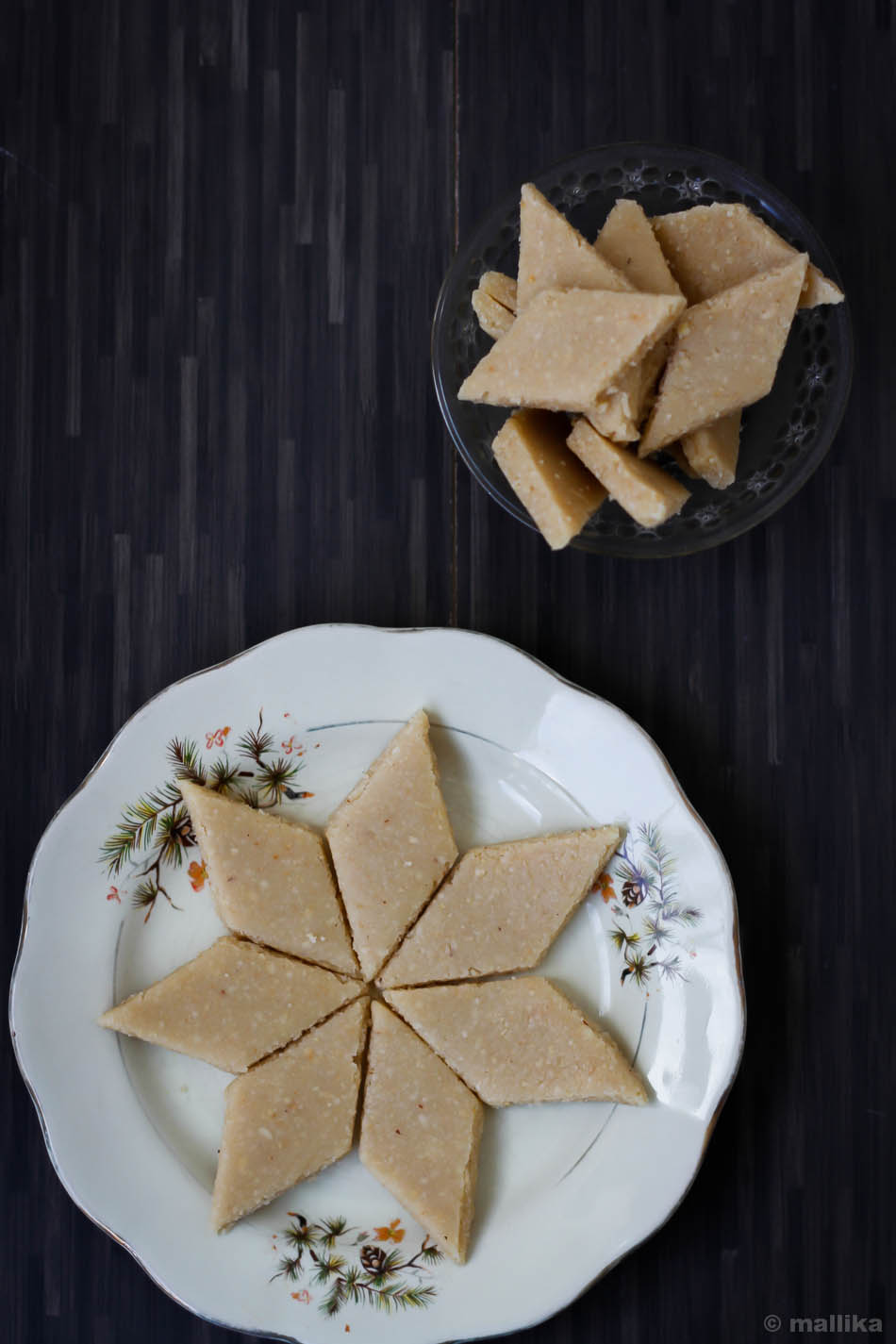
One of the recipes that aunty shared with us that evening was the recipe for this Kaju Katli, a popular cashew based sweet that's a popular family favorite in many homes, especially in the North, where gifting boxes of sweets is customary to their traditions. Although we are past Diwali now, I don't think this requires any occasion for celebration. You can make them at home, at your convenience anytime and feel pleased with this indulgence. If you have a weakness for Kaju Katlis, then I am afraid you may not be able to resist eating just one.

Kaju Katli_1


Making these burfis at home may sound intimidating, but it isn't. This was the first time I attempted making them at home and they came out delicious. I started off nervously even as I measured the amounts suggested by aunty, but she had assured that the recipe would work even for the most novice, immature cook, and that assurance itself wanted me to try this recipe in the first place. The end result ofcourse was smooth, melt-in-mouth goodness of cashew fudges.

There are many ways to prepare this dessert. A common one being where the cashew nuts are soaked in water overnight and ground the next day, then cooked in single-strand sugar syrup till it comes together to form a dough. As an alternate, easier method, you can grind the cashews to a fine powder and mix with sugar syrup, cooking it on a low flame to form a soft dough. The dough is then spread and flattened on a plate and cut into thin diamonds. Commercially sold katlis have a layer to silver wark on them, however, for a home version you can skip them totally. This version of kaju katli is an easier where you do not have to worry about sugar syrup or its accurate consistency. Hence, time saving and easier which gives you the burfis of same quality as bought at a store.

Kaju Katli_2


Kaju Katli | Cashew Fudge

INGREDIENTS

2 cups cashewnuts, heaped
1 cup sugar
1/2 cup water
1 tbsp. ghee (approx. 3 tsp.)

DIRECTIONS

Grind the cashews to a fine powder in a mixie. I used the chutney jar as the whiz option on my mixie helps me control how fine I want the cashews to be powdered. Ensure that the cashews are not powdered to an extent that they begin to leave oils.

Heat the sugar and water in a thick bottomed pan and stir well till all of the sugar is dissolved in the water. Just as it comes to a rolling boil, add the cashew powder and stir well on a low flame.

The cashew mixture will soon come together and begin to thicken. Once it thickens enough to form a mass / sticky dough / lump, add a teaspoon of ghee. Remove the whole of the mixture from the pan.

Transfer the prepared mixture on to an upturned greased plate or a butter paper. I used a marble chakla. Allow it cool a little. When its cool enough to be handled, knead it gently to form a smooth dough. If the dough is too stiff and find it hard to knead, add another teaspoon of ghee. This is optional though.

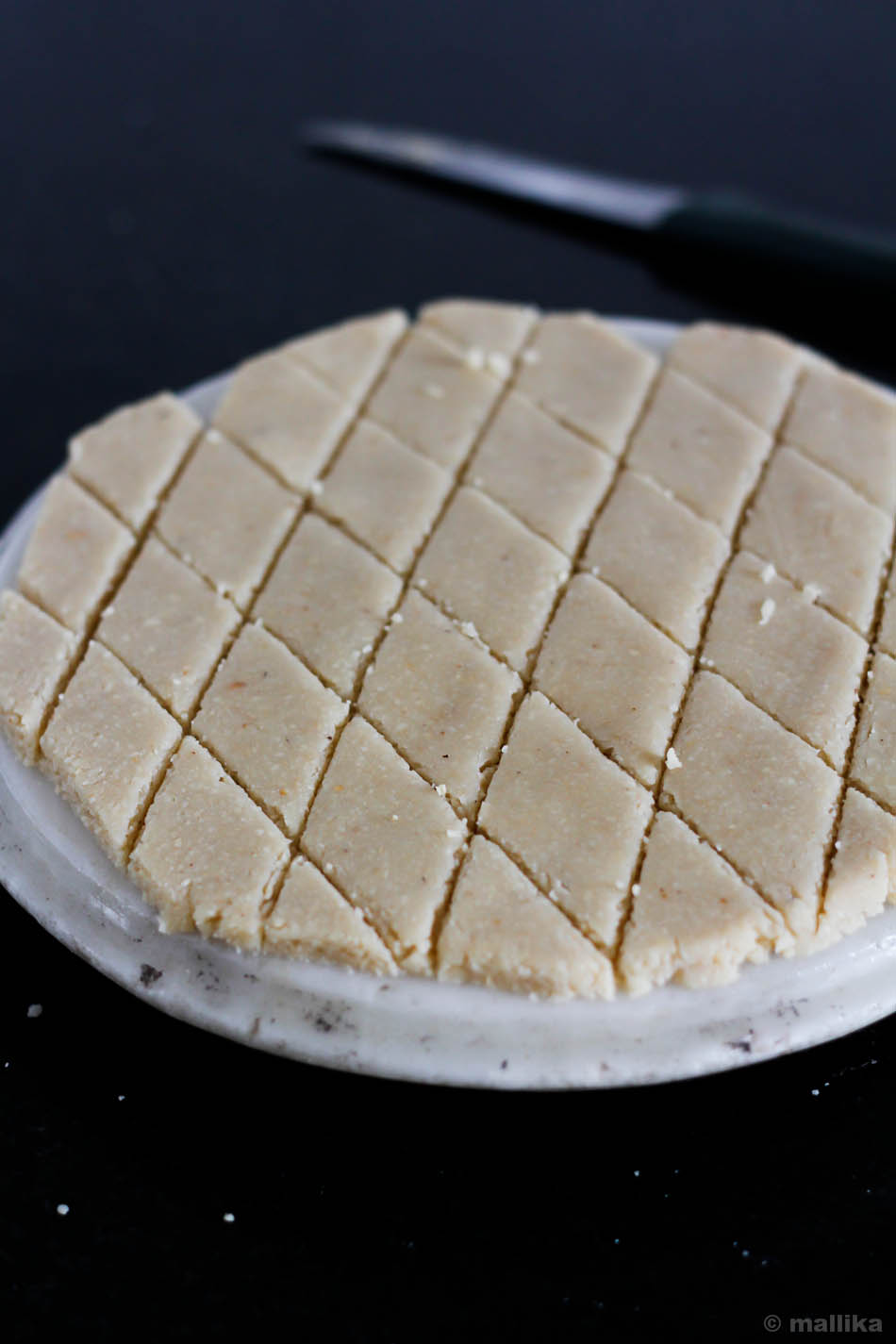
Using a greased rolling pin, roll the dough gently and evenly till its about 4-5 mm thick in height. Allow to cool. When cooled completely, use a sharp knife to cut the cashew fudge into diamond shapes. Gently transfer the kaju katli to serving plate or store in an air tight container.

Poha Chiwda

How to make Poha Chiwda | Avalakki Chiwda | Namkeen | Indian Snacks
With a vacation gone by, now that I am back in India, kind of jostled into a routine, placed our daughter in school and have resumed work full time, you would probably expect this to be sort of a travelogue post walking you though dozens of photographs from places far known and unknown, painting a picturesque comprehension for each. Let me put all guesses to rest. I may have been back here, but my mind is still in the roving. It wanders back and forth to the good time we spent with D. I would love to do a short walk through of the places we visited, which was in plenty. We spent good moments doing things together in threesome, but I feel simply unwilling to dig into those photographs and bring those moments into words here. Some things are best left that way. Imprinted in memories. When mere words cannot do justice.

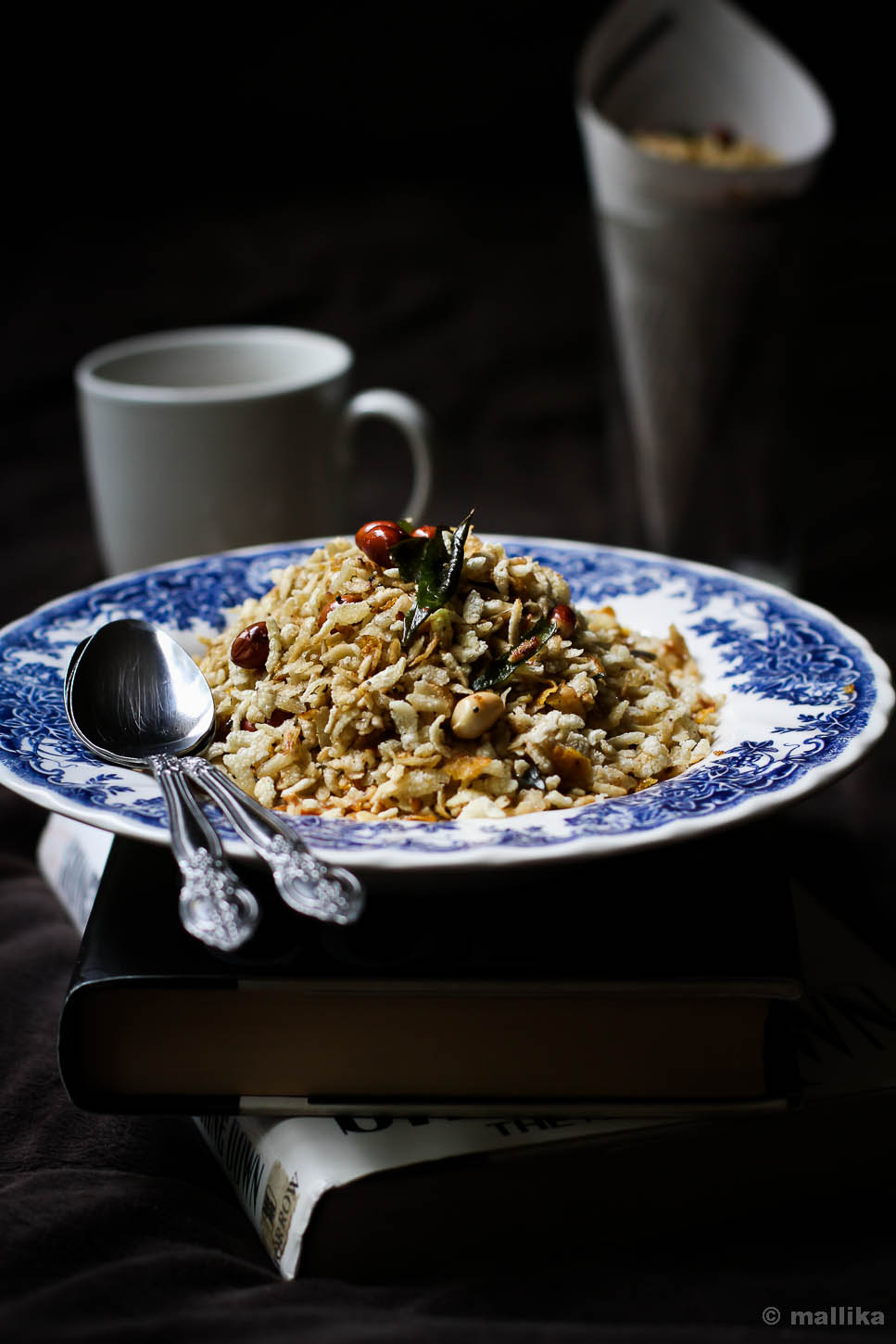
Poha Chiwda


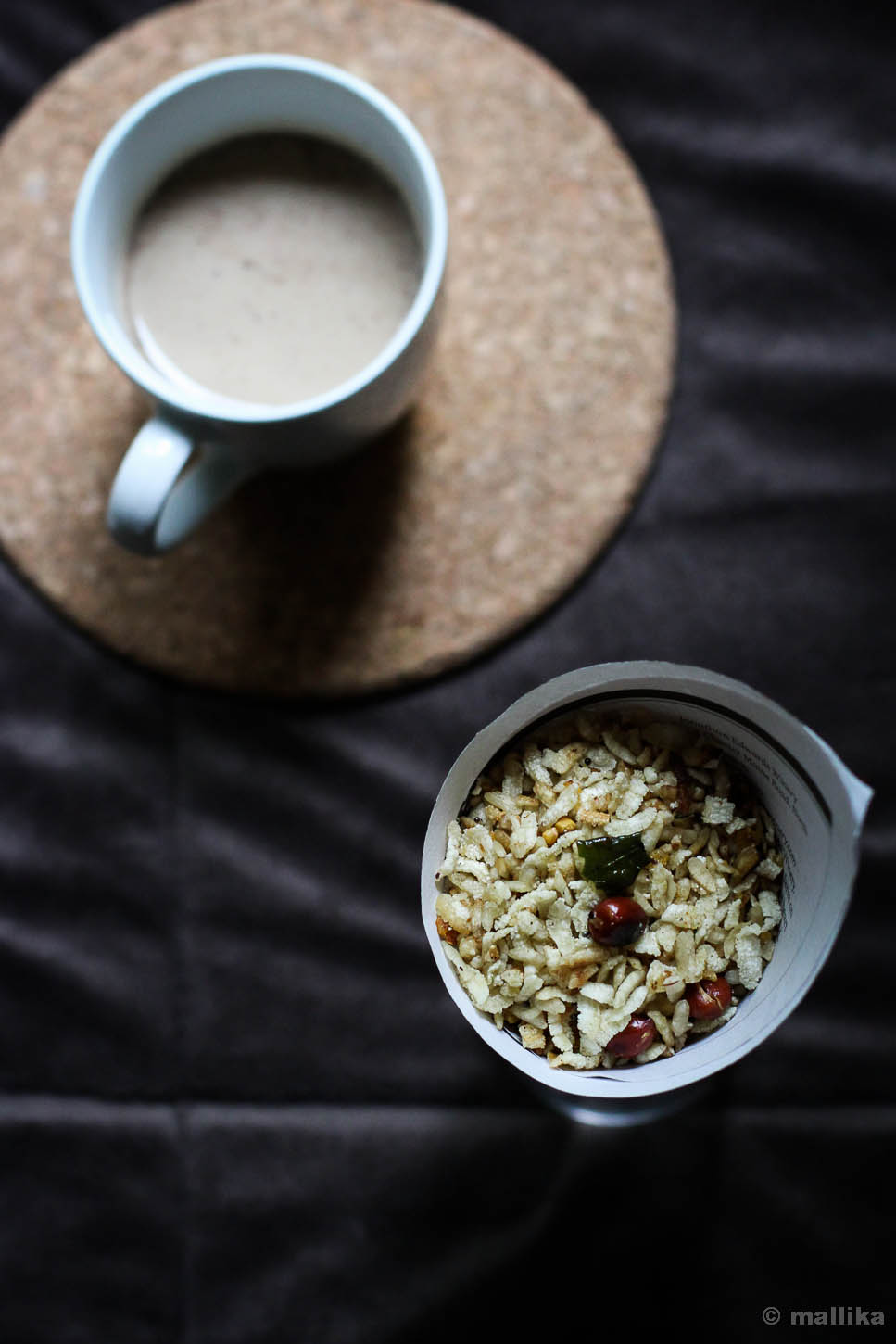
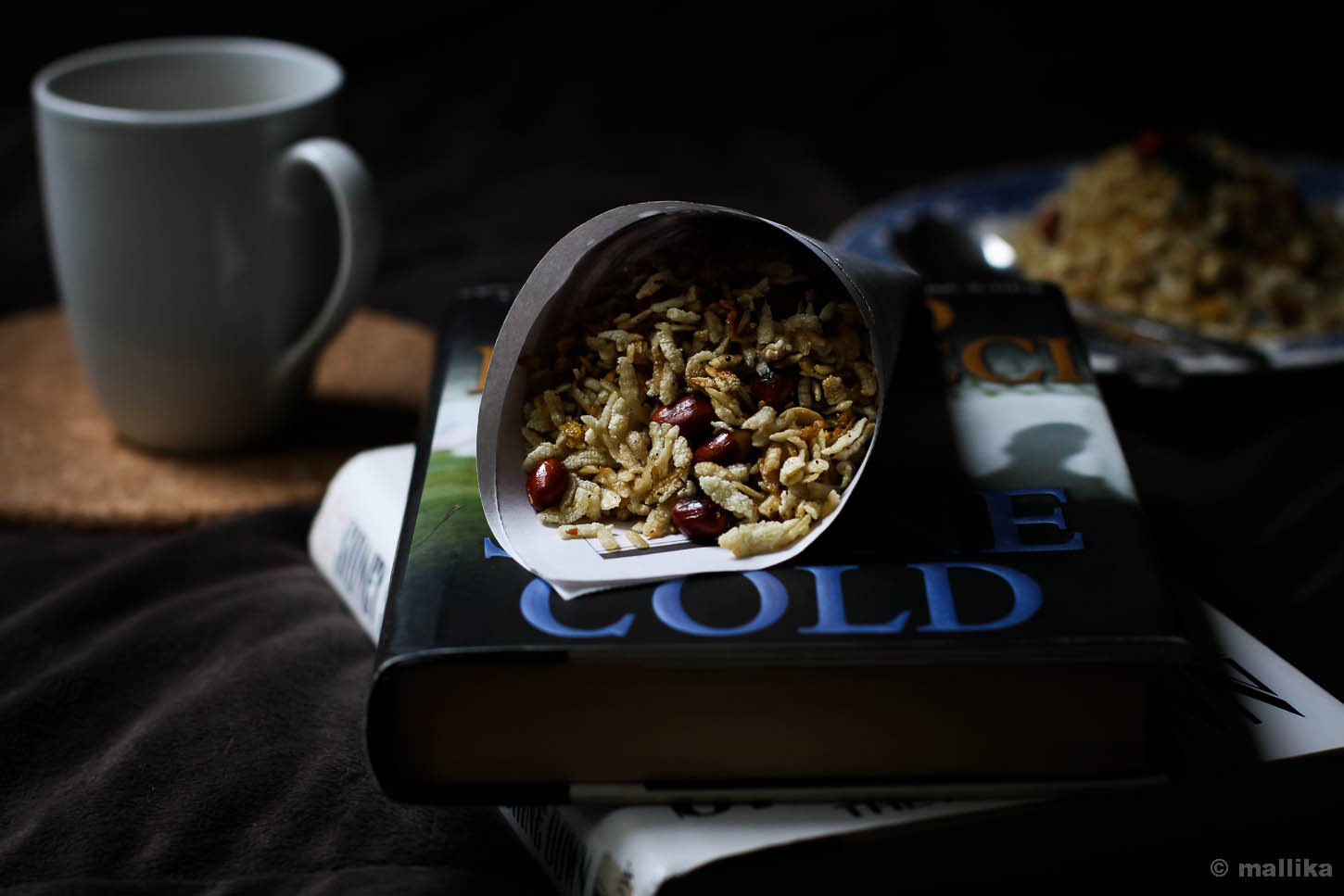
So as it goes, this is no travelogue kind-a post, but a recipe for an Indian savory snack I made in huge batches during our time in the US. We savored it by bowls on several evenings sitting by the wooden porch that overlooked the thick woods in our backyard. The moments slipped away without notice as we sipped into hot chocolate and tea, scooping spoonfuls of chivda into our palms, slowly savoring its crunch, while we tended to the young tomato plants that bloomed tender yellow buds in our garden.

On weekdays when D was away at work, the chivda became my sole savior as I flipped through light reads under the wraps of summer and streaks of golden sunlight. As the afternoons tranced into early evenings, there were days when our little girl kept herself busy dressing up her dolls, setting up the table and putting up a pretend birthday party for them. I would briefly give her company in the initial part of the play, pretending to be her helper, then, slowly whisk away to make time for myself, to play with real pots and pans in my kitchen that belonged to me.

Then, there were other days when she would get busy soaking up her fingers and clothes in spectrum of colors as Elsa and Sofia got painted in colorful attire in a way only she would fantasize. Their frills and veils were painted in reds, greens, blues, browns and whatnot, smudged in uneven tones and stressed outside the lines meant to define these beautiful damsels. That's the time I borrowed for myself in the kitchen, to dish out some delectable savory snacks that made us through those evenings till we waited for D to return from work.

Poha Chiwda


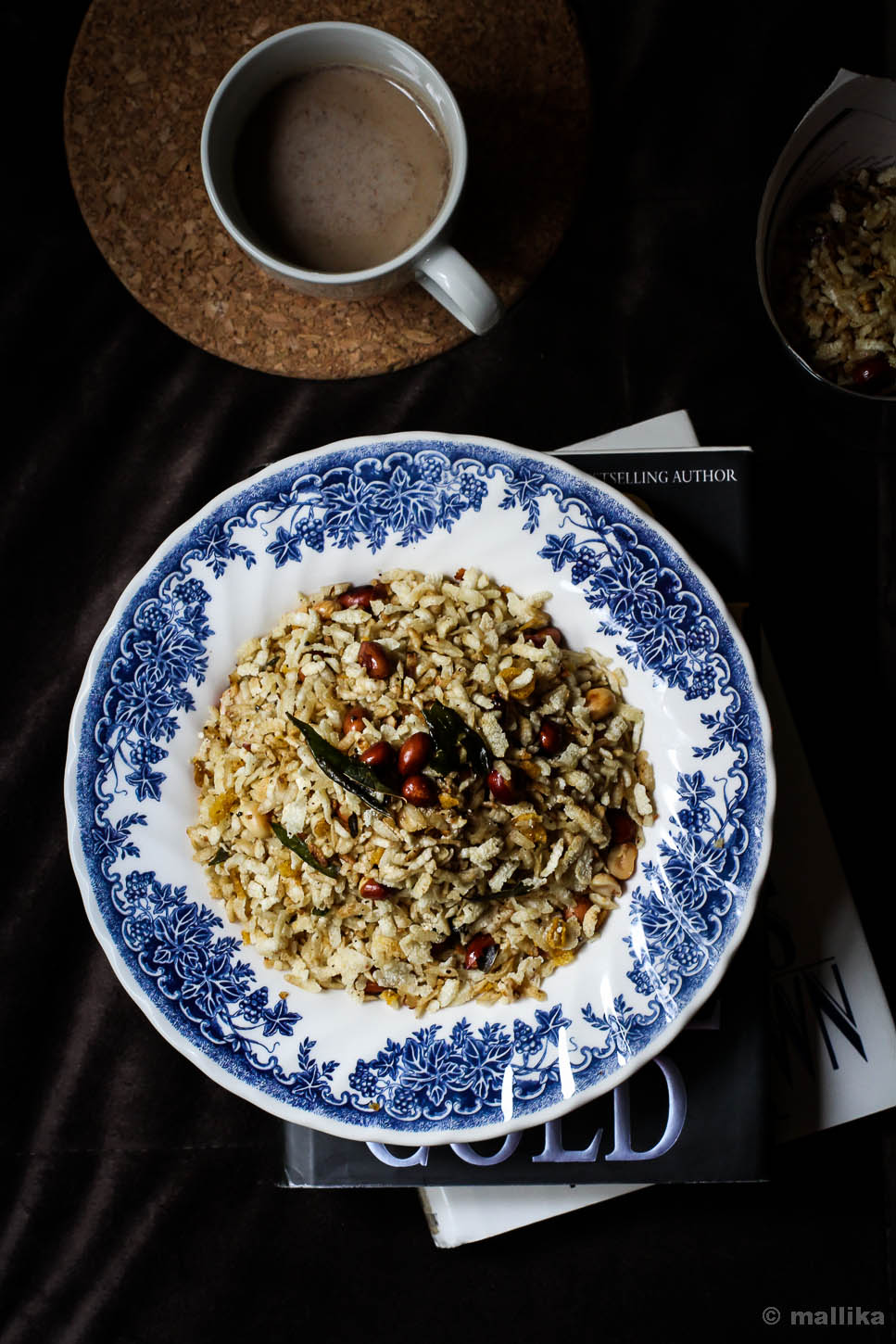
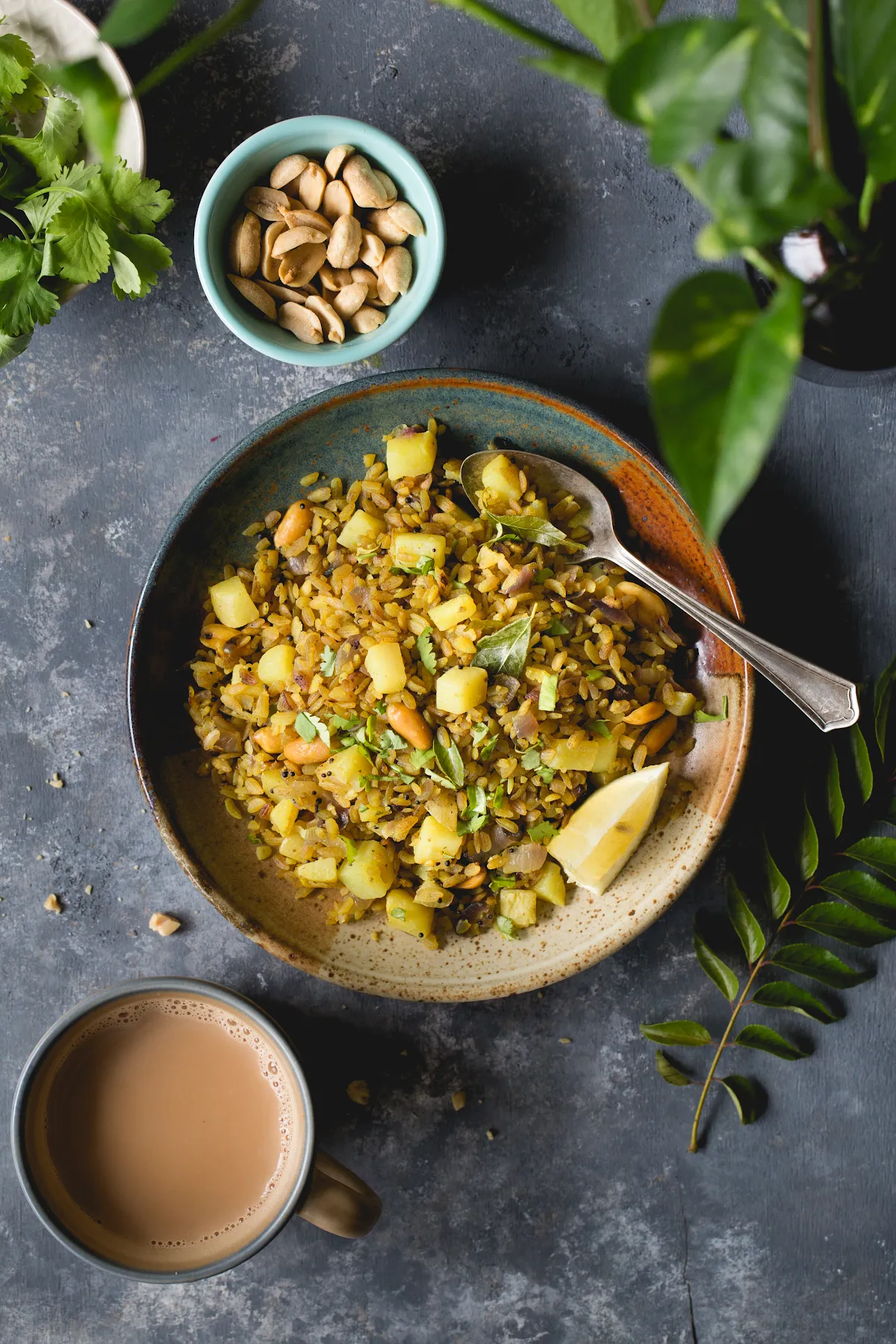
This Poha Chivda may remind you of your childhood spent visiting your relatives or friends, or of festivals like Diwali and Navrathri, when aunts brought in bowls of savory snacks served along with piping hot tea. Poha Chivda was and probably is still a common tea time savory dish in many Indian homes, served mid-noon along with tea or coffee, often store-bought and rampantly available in transparent polythene packets in every bakery and grocery store possible. Almost every house probably has had some version of it. At home, we call them all just 'chivda', which simply means an assortment of fried and seasoned ingredients usually with a base of flattened rice or cornflakes. Chivdas come in varieties, but there is no hard and fast rule on how you wish to make and what you wish to season them with. The store-bought ones are usually heavily seasoned and spicy, but I like to break rules and keep it simple, light and flavorsome.

My version here is quick with minimal ingredients. Its quite common to use fried cashews, raisins and sesame seeds for a more assorted rich taste. It takes about 15-20 minutes to put all of this together from start to finish. You could use fried whole red chillies instead of red chilli powder to reduce heat further. If you wish to try a low fat version and bake the poha, let me know how it works for you. For once, when I tried a baking attempt at this, it failed miserably. Try this and let me know how you like it.

Poha Chiwda


Poha Chivda | Namkeen Chivda | Avalakki Chiwda | Seasoned Flattened Rice

INGREDIENTS

3 cups poha / flattened rice (use thick variety)
1/2 cup peanuts
1/2 cup roasted gram bengal dal / channa dal / huri kadale
2 sprig curry leaves
1 tsp. oil for tempering
1 tsp mustard seeds
1/4 tsp red chili powder
1 tbsp. sugar or as required
Salt to taste
Oil for deep frying

DIRECTIONS

Heat enough oil for deep frying in a wide mouth pan or kadai or wok. Using a wide mouth strainer or a slotted spoon, deep fry the poha in hot oil. Do this in batches so that you fry them evenly till they swell up and become crisp. Remove and drain over a plate lined with kitchen paper. Fry all of the poha and set aside. Into the same oil, fry the roasted bengal gram dal till its golden brown. Remove and drain again on a kitchen paper. Next, fry the peanuts in this oil till reddish brown in color and drain on a kitchen paper. Fry the curry leaves till they crisp up. Drain and set aside.

Heat a teaspoon of oil in a separate pan. Fry mustard seeds till they pop. Add the red chili powder and mix in all the fried ingredients. Sprinkle sugar and salt to taste. Roast this for 2-3 minutes on a low flame to ensure all the spice, salt and sugar is well combined into the poha mixture. Adjust the spice according to your taste by adding more red chili powder if required.

Allow the chivda mixture cool completely. You can store this in an air-tight container at room temperature for couple of weeks.

Poha Chiwda

Spiced Roasted Walnuts


Right at the fag end of the year, in midst of the festivals that went by past month and more awaiting the mark of year ending, here I am making every sincere attempt to blog and replenish my repertoire with some recipes to tease your taste buds. With barely a blog post a month in the recent past, I have been panting hard to fuel this space with enough meat off late, more evidently seen from the sparse posts that pop out of my drafts occasionally or my dwindling presence on any social networking forum. The motivation, that has been lacking from several other personal commitments consuming my time and the dear camera lens of mine that gave upon me recently. Yet, at the hindsight of my brain lingers a constant thought to fuel this little space of mine with recipes, even if that means battling a writer's block or picking an offbeat recipe from my drafts for a go.

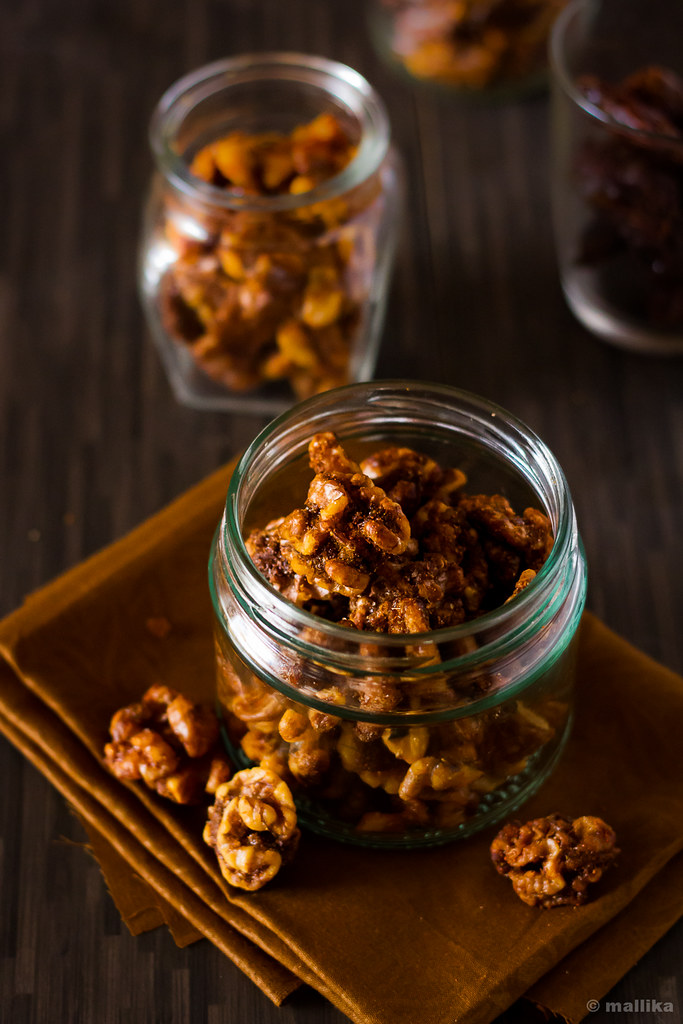
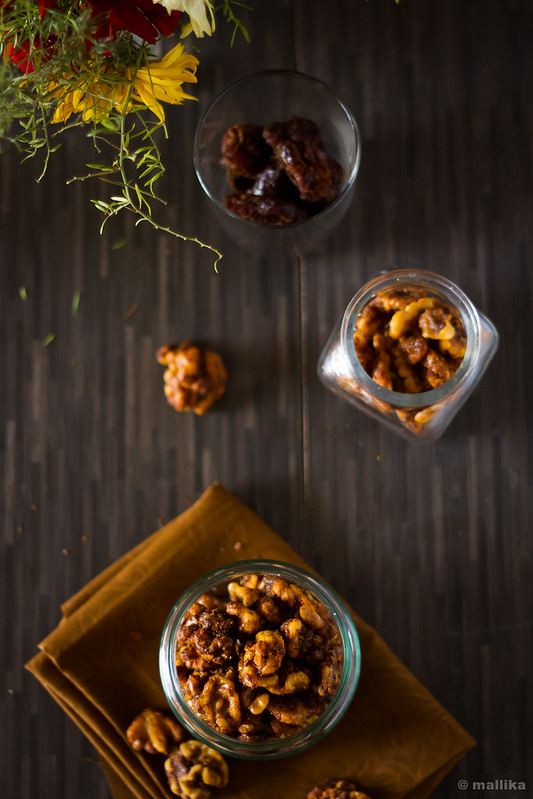
Spiced Roasted Walnuts_Prep1 Spiced Roasted Walnuts


It hit upon me hard how fast the time is fleeting by and how much close we are to the year end when the folks at Sheraton reached out to me to be a part of their Cake Mixing ceremony. December already? Almost. I think hard. My thoughts racing by. My heart pounding faster. Where and how did I let the time go? The Indian festivities crept in and they slid by sooner than I had realized. We cooked a lot. Partied, merried and ate well too. The usual course of chalkis, laddus, karjikai, shankarpali, nippattus, masala shenga and whatnot was followed this season too. We made them all at home and saw joy in sharing them with our family and friends. But none of them made it here. And I barely realized it go by.

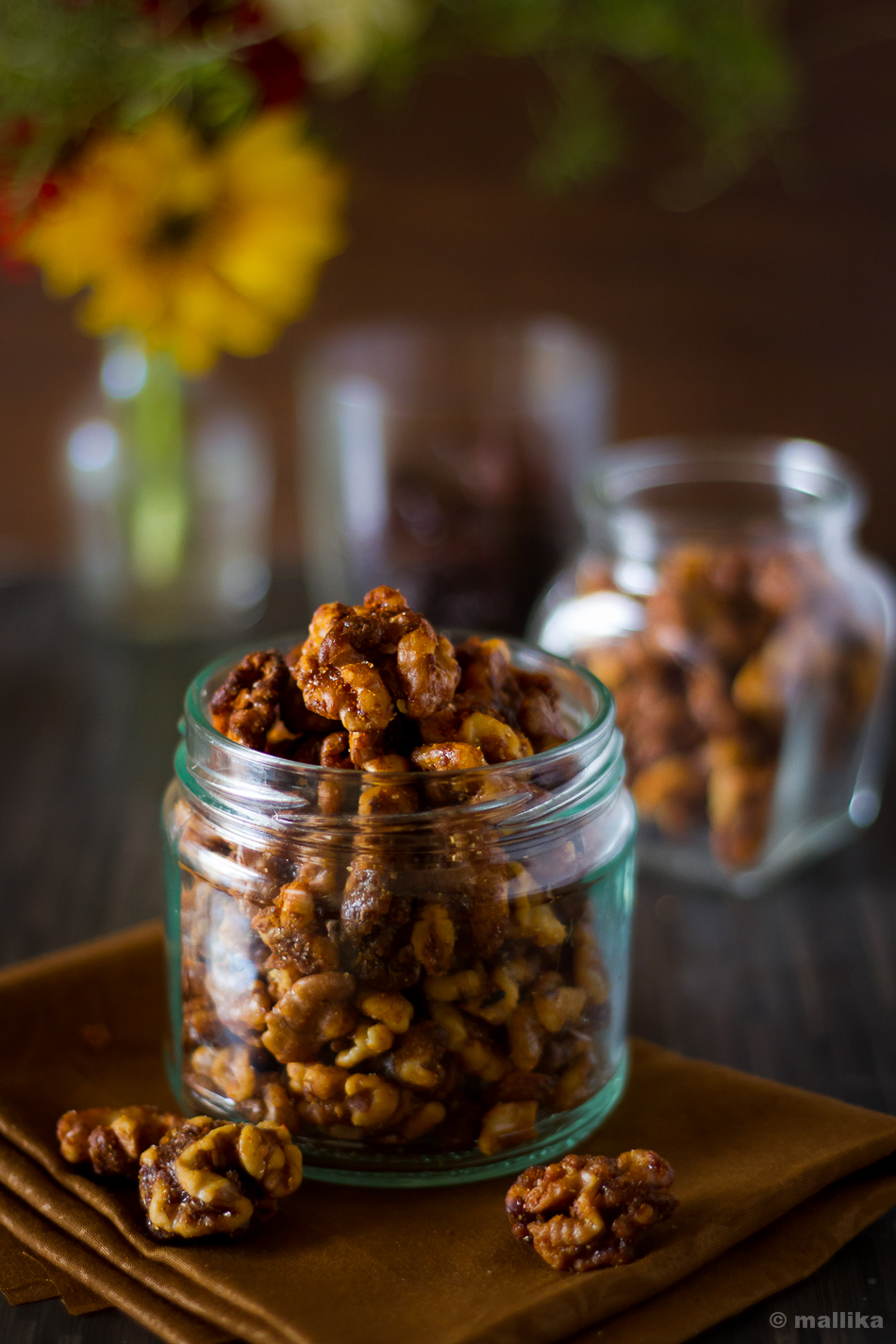
So I bring about these simple, deliciously spiced and roasted walnuts for the Thanksgiving today. The spices that go in it to tangle the taste buds with measures of salt, spice and sweetness. They are baked and can be stored for a while. They make excellent for gifting your friends and relatives. And I hope they make up for the loss of all those recipes I have been meaning to post here for a while!

Spiced Roasted Walnuts


Spiced Roasted Walnuts

INGREDIENTS

1 tablespoon honey
2 teaspoons olive oil
2 cups walnut halves
2 tablespoons sugar
1 teaspoon coarse salt
1 teaspoon ground cumin
1/2 tablespoon ground coriander
1/8 teaspoon red chilli powder

DIRECTIONS

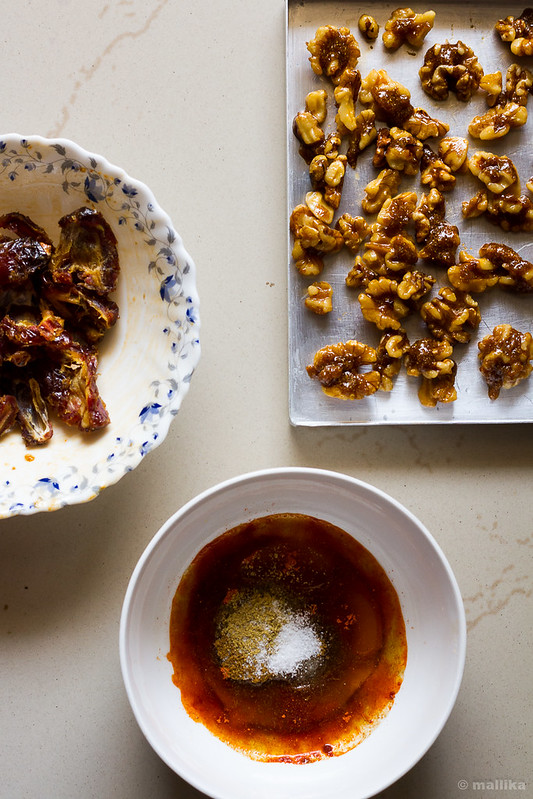
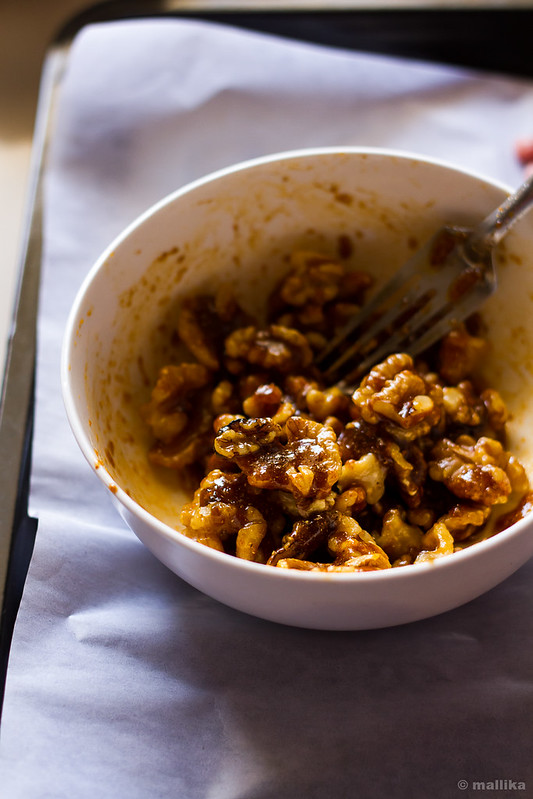
In a large bowl, whisk honey and oil. Add in the sugar, salt, cumin, coriander, and red chilli powder. Toss in walnuts; mix well to coat. Transfer to a baking tray and bake in a pre-heated oven of 200 deg C for atleast 20 minutes. Remove and allow to cool completely. Store in an air-tight container.

Spiced Roasted Walnuts


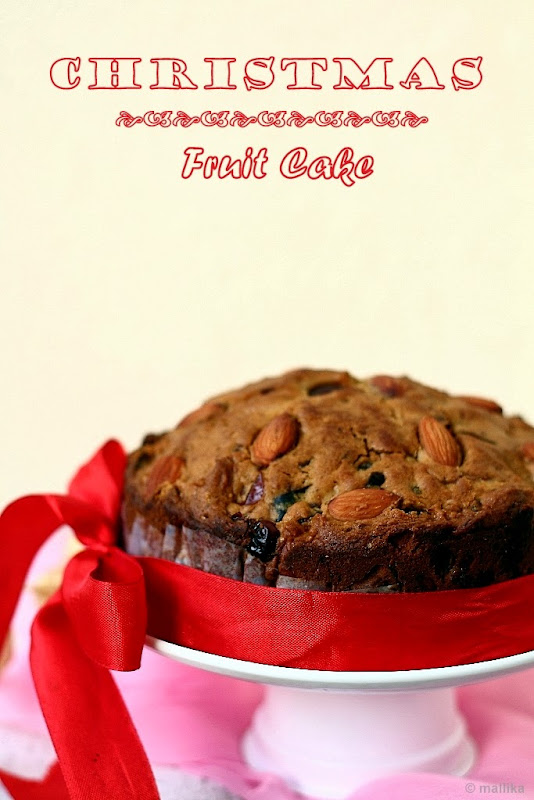
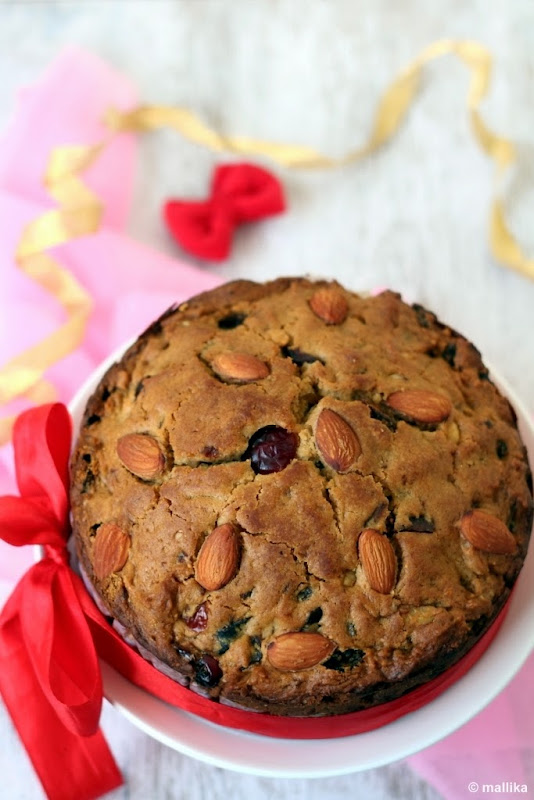
Christmas may have been over, but as we move closer to the year end, the celebrations are still on. On a Sunday last fortnight, I flipped through Nigella’s book, 'How to be a Domestic Goddess' wondering if it held some fool proof traditional recipes that I could bake for Christmas this year. The first thought that comes as obvious, is baking that traditional Fruit cake that I was brought up eating during the Christmas time. Of course, those were the store bought ones.

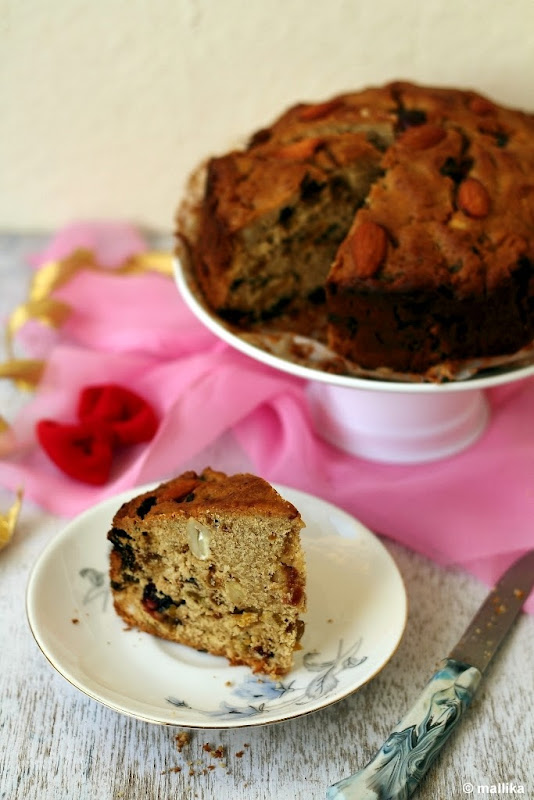
For long now I have been baking mine at home, made fairly the traditional way by soaking fruits, peels and all of that in liquor of some sort for months, before it can be thrown at ease to bake the Fruit cake that can sit for some time, mature and liberate flavours to be brought out at the table during Christmas. It’s good and so good that many a times, it sees end before Christmas. Probably it’s the only time I step into a liquor boutique with no qualms, the time you’ll see me meddling around with mounds of dry fruits, scrapping citrusy zests, amassing peels, chopping nuts and doing all that soaking and sniffing, intoxicating myself in warmth of some boozy fruity aroma. It’s often during this time of the year that I sprint to action with baking that leaves me satisfied immensely, because I love the charismatic happy faces, the assuring smiles by people while sinking their teeth into homemade fruit laden cake. And every so often if time be at hand, I do not hesitate to bake eggless versions that can be relished by my dad too.


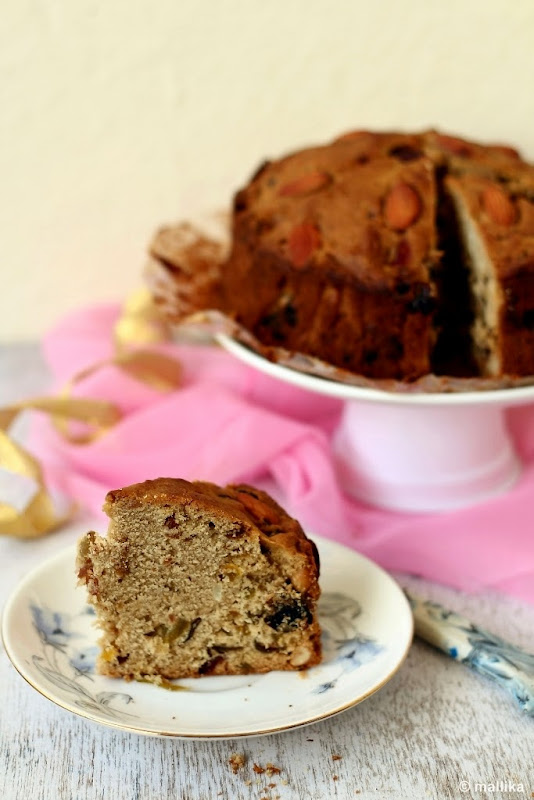
I do seek for trivial changes I can make each time, sometimes follow a different recipe too. This time around when I flipped through Nigella’s book, How to be a Domestic Goddess I jumped in joy to see her recipe for traditional Fruit cake under Christmas section and that for sure made my thoughts clear that I wanted to go with it. While the recipe itself is great, my cake turned out a tad bit dry. But then that’s entirely my fault. I followed the recipe to tee carefully weighing out the ingredients on the scale, but soon realized that my butter weighed just 72gms as against 110gms I needed. My husband who kept an occasional tame watch rolled his eyes, as he saw me flip almost an entire pack of butter into the cake batter and then weigh out rest of the oil. He almost shrieked as I made my way to add the oil and suggested I should do without it! I found that 235gms of flour was sufficient as the batter got quite stiff and added a teaspoon of baking powder for the rise. Nevertheless, it still tasted great.


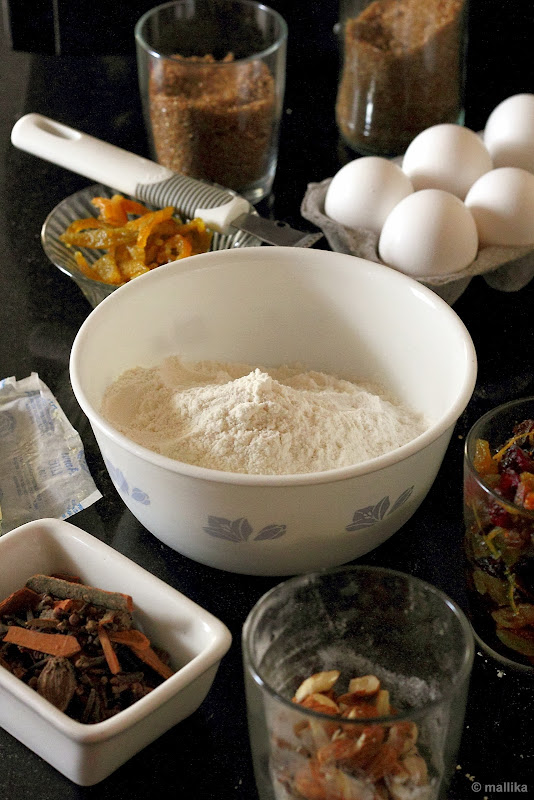
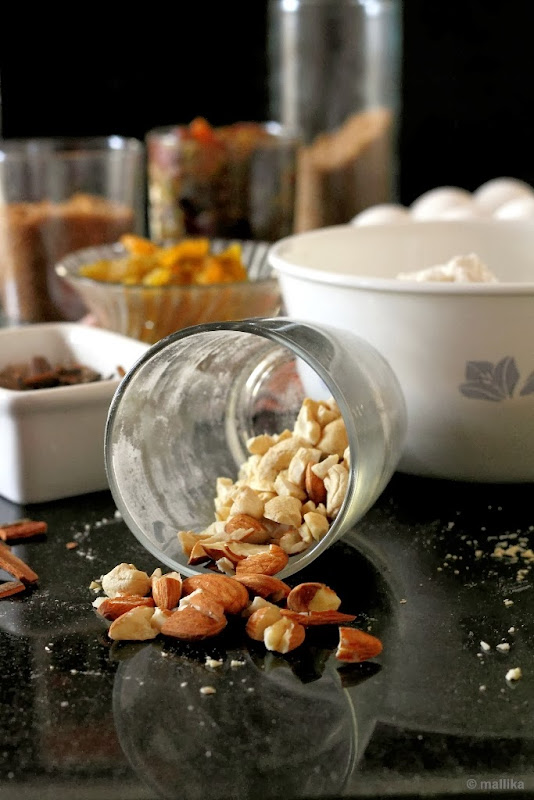
I have made fruit cakes with rum in the past, however here I went ahead with brandy as suggested in the recipe. I am not a connoisseur in wines so I can’t really differentiate. While Nigella lists out each ingredient for dry fruits separately, I substituted the same with the homemade mincemeat and candied orange peels I made earlier. To add an extra touch, I added handful of almonds and nuts to the cake batter. The fresh grated ginger is optional, but adds a beautiful spicy warmth to the cake. The cake needs to be stored in a cool, dry and dark place and stays as long as 6 weeks. If you can't use alcohol in your cakes then I urge you use orange juice as an alternative. However this may reduce the life of the cake as the alcohol helps to act as a preservative.


Nigella’s Boozy Christmas Fruit Cake

INGREDIENTS

110 g salted butter
2 large eggs
90 g brown sugar
1 tbsp. marmalade
235 g plain flour
125 ml brandy
2 tsp. baking powder
300 g homemade mincemeat
100 g chopped nuts (optional)
1 tsp. all spice mix
1 tsp. grated ginger (optional)

DIRECTIONS

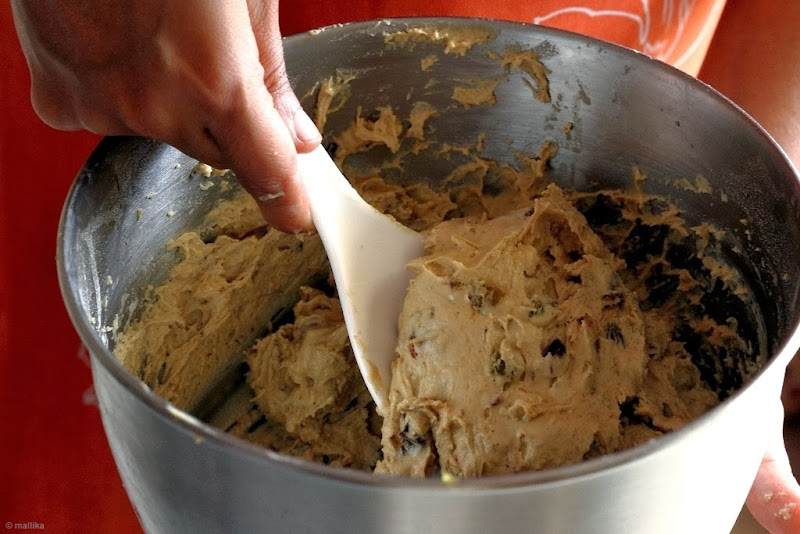
Preheat oven to 180 degrees C. Sieve the flour and baking powder into a clean bowl. Add in the nuts (optional) to this and coat well. If you wish to notch up the spices, you may also add in some grated ginger or more all spices mix to the flour. Separately, cream the butter and sugar. Add in the eggs, followed by the prepared mincemeat, marmalade and liquor to this and whisk well. Next add the flour, baking powder mix into the wet ingredients and stir till there are no lumps. Add in any additional dry fruits and nuts if preferred. Butter and grease a 8 inch loose bottom cake tin and line with grease proof paper. Pour the cake batter into the tin and cook for approx. for an hour. Insert a toothpick and test. Remove and allow to cool on a wire rack. This can be stored well for couple of weeks.


Gifting or exchanging gifts during festivals per se was never a part of our culture. The only form of festive gifts were probably the homemade sweets and savories we shared with our family, friends and neighbours. However life changes to an extent after marriage, where embracing new culture, their lifestyle and values become essential to maintain the social associates. Exchanging gifts, termed as Shagun is an integral part of my husband’s side of family. Be it an occasion, a festival or just a casual greeting, it is inevitable to exchange gifts as a gesture of love and respect. For someone like me who had never seen this in my part of the world earlier, this seemed a bit prodigal and odd initially. Over years though I have learnt to accept and appreciate this culture and own it as well.


Festive gifting, particularly around this time of the year seems to be gaining a lot of popularity in India too. As known for a fact, Christmas was always associated with sharing of gifts by Santa Claus. As a kid I have lived by my share of dreams and fantasies, hanging stockings by the bedside and window sill around Christmas time, secretly hoping that some Santa would come by riding on his reindeer on this big night and drop a surprise gift that I had been longing to own as mine. I must say assertively that over the many years I hung my stockings by the window sill never did a Santa come by or drop goodies into my stockings. I realized eventually there existed no Santa, nor would my stockings be ever replenished with gifts, so I gave up on them. I wonder though why my parents never bothered to drop any goodies in there. Least I think, as a bribe that idea would have been fab.

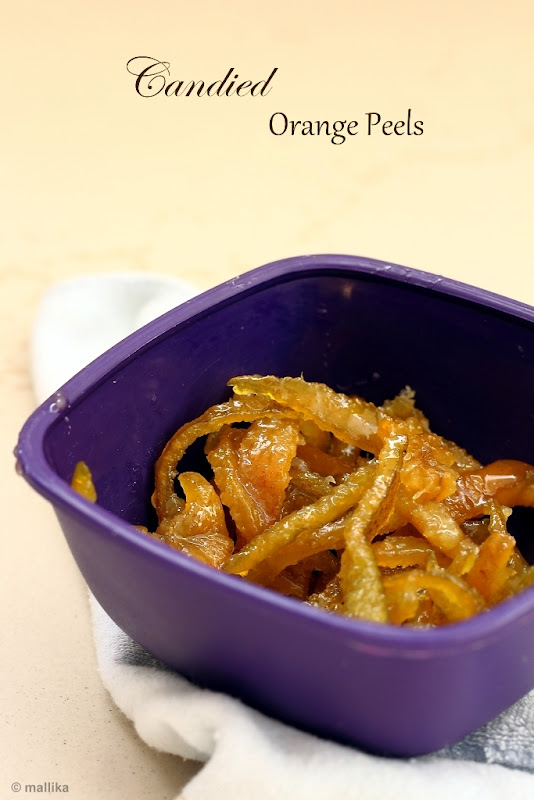
With Christmas just around the corner and keeping in mind that these can make great give away gifts to your family and friends this season, I have 2 recipes for you today. The Home-made Christmas Mincemeat is purely vegetarian, much unlike of what it's name suggests. The inspiration to make these came from Nigella Lawson's 'How to be a Domestic Goddess', however the recipe for the same is tweaked and adapted from David Lebovitz's Quick & no-cook Mincemeat recipe I came across here; while the Candied Orange Peels are such delicious bitter-sweet treats that you will love to munch them as is or use in various recipes.


Home-made Christmas Mincemeat

INGREDIENTS

175 g raisins
100 g sultanas / black currants
100 g dried cranberries
100 g candied peel, finely chopped
175 g soft dark brown sugar
Zest of 1 orange
Juice and zest of 1 lemon
1 tsp. all spice mix (a freshly ground with cinnamon, cloves, cardamom and nutmeg)
5 tbsp. brandy

DIRECTIONS

Mix all the ingredients together and stir well. Spoon this into clean and sterilised jars. I sterilise my jars by placing them in warm oven for couple of mins. Allow the flavours to mature for at least 2 weeks. This works great for pies, tarts, Christmas cakes and puddings.


Home-made Candied Orange Peels

INGREDIENTS

2 large thick skinned oranges
2 cups sugar, divided
1 cup water

DIRECTIONS

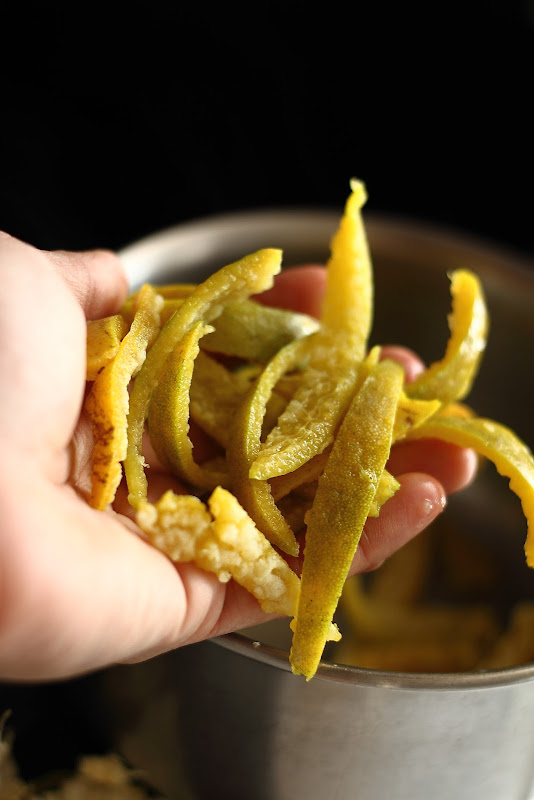
Neatly score the oranges into quarters. Remove all the flesh neatly and retain the peels. Carefully scrape off the white pith as much possible so that the zesty orange peel can be used. The white pith will render bitterness to the oranges, hence its essential to remove all of it for best flavours. Chop the peels into 1/4-inch-wide strips as shown above in the 2nd picture.

Drop these peels into cold water. Bring this pot of water to a rolling boil. Drain off the water and repeat this twice with a new batch of water. This will soften the orange peels and mellow down the bitterness.

Next, in a thick bottomed pan heat 2 cups of sugar with 1 cup of water. Bring to a simmer and cook till it reaches one thread consistency. Add the peels and cook further till most of the sugar coats the peels and the peels get translucent. Remove from the flame and drain off any excess sugar. Place them on a tray and allow to dry further if you wish to store them. You may also roll them in castor sugar if preferred. However, I used them on the following day in recipes for Homemade Mincemeat (recipe above) and Christmas fruit cake.

_MG_5757


Uddina ambade, Medu wade or uddina wade are all practically the same. Its all about the shapes. Uddina wade / medu wade are round, donut like with a hole in the center to ensure even cooking of these fried fritters and are often served with idlis or enjoyed as is for breakfast. Uddina ambade are smaller, round shaped fried fritters made with the same ingredients, often served as a tea time snack or as an accompaniment to an elaborate meal. In Mangalore, these very popular evening snacks are also sold as Biscuit ambades in konkani outlets and are relished with a spicy coconut chutney and tea or coffee.

Frying is not my forte. I panic, fumble and get fussy. While anything that is fried always tastes sinfully good, I hate the preparatory and the after work of cleaning oil and vessels that accompany it, also the fact that frying needs constant attention and hand work at the wok at all times. It's occasionally I get into those adventurous shoes when I think my husband and daughter deserve these treats atleast once a while!

These ambades are traditionally served with simple white coconut chutney. But for a spicy twist, I made a Tomato Peanut Chutney that my husband absolutely adores. I have made this chutney on several occasions and they go quite well with idlis, wadas, dosas and akki pundi. I reserve to post the chutney recipe for another day as they do deserve a dedicated post. Do try these ambades and let me know how you loved them.

_MG_5759


Uddina Ambade | Black Gram Fritters

INGREDIENTS

1 cup urad dal / black gram
5-6 whole black pepper, broken roughly in a mortar and pestle
2 green chillies, finely chopped
1 sprig curry leaves
1 tsp. finely chopped ginger
2 tsp. grated fresh coconut
Salt to taste
Oil for deep frying

DIRECTIONS

Wash the urad dal thoroughly and soak it in water for atleast 3-4 hours. This will help to soften the dal. Drain all the water out and grind the dal to a fine paste adding as little water as possible. The batter should be thick, but not stiff. Stiffer batter will result in dense ambades, while runny batter will soak in a lot of oil while frying. Incase the batter seems runny than thick, then you may add in a tablespoon of rice flour. Rice flour also makes the ambade crisp, so a teaspoon of it helps. The key to getting good ambades are in having the right consistency of the batter. Transfer the batter to a bowl and add in the finely chopped green chillies, ginger, grated coconut, peppercorns and salt to the ground batter. Beat the batter well with a wooden spoon and set aside.

Heat a wok-full of oil till its medium hot. Test the oil by dropping a pea sized batter to the oil. If it sizzles and rises to the top then the oil is ready. Lower the temperature and using a spoon, drop small dollops of batter into the oil side by side till they have just covered the oil. Do not overcrowd them, else they will be undone in center. Fry them on slow flame till they are golden brown. Remove and drain on a kitchen paper. Serve hot with chutney of your choice.

_MG_5755


I was nine when I first learnt swimming. Well, nothing really one should boast about, but then I remember the day so well that I can’t help but bring in reflections of that day here.

My magenta pink swimsuit, the matching swim cap and those bright hues in shades of sky blue and baby pink swimming tube without which we would never enter the pool. Dad would wake us up as early as 5.30 am, hand over a tall glass of milk each that the three of us would gulp down, get us ready and drive us down to the pool. As we took our showers and came out to step into the pool, dad would help us float our swimming tubes around our waist. My sister and I spent couple of months that way with those fluorescent plastic tubes balancing us on water and that clearly meant we would never learn swimming with those tubes on. Dad decided one day that we should forsake the tubes and on the pretext of having forgotten them at home, he coaxed us to throw our arms and beat legs to learn swimming. In a week’s time or so, with good coaching and motivation from dad and the coach, I managed to swim my first 20 meter stretch, that stretch of the pool I can recall well even till date. Back home, my mom was a happy lady. She needed a reason to celebrate and my learning for the day became a reason to cheer and so this vermicelli kheer was made to revel my first swim.


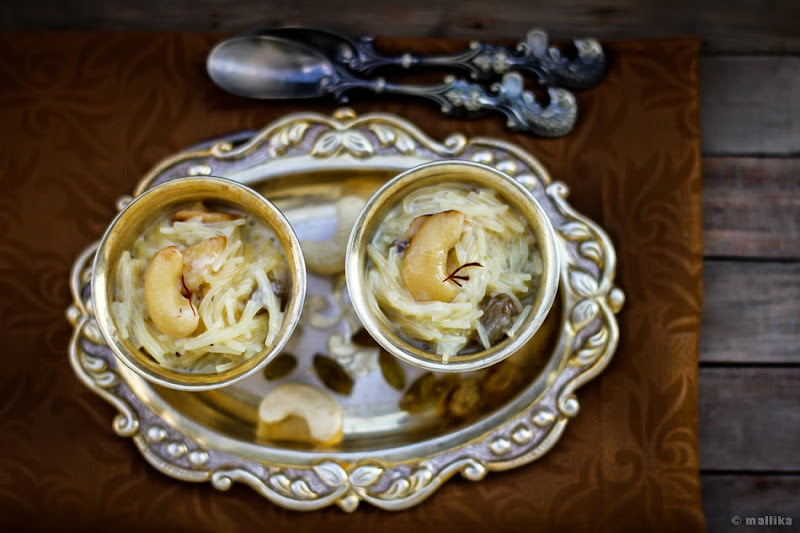
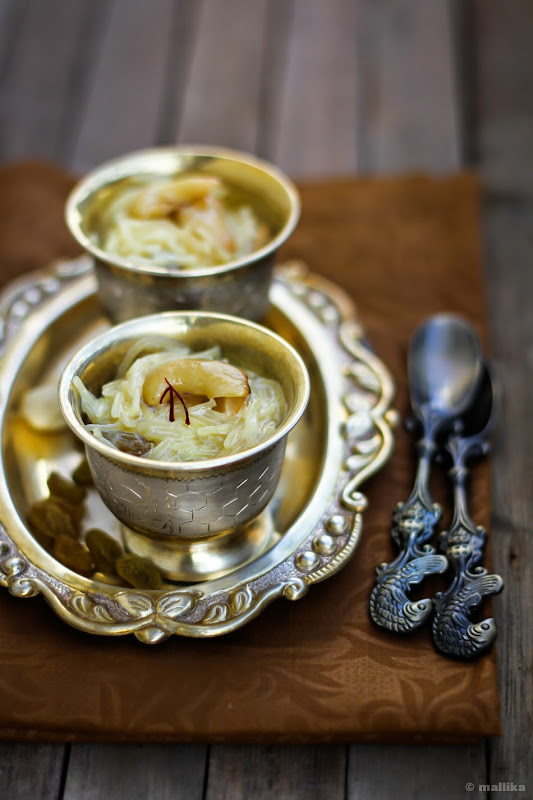
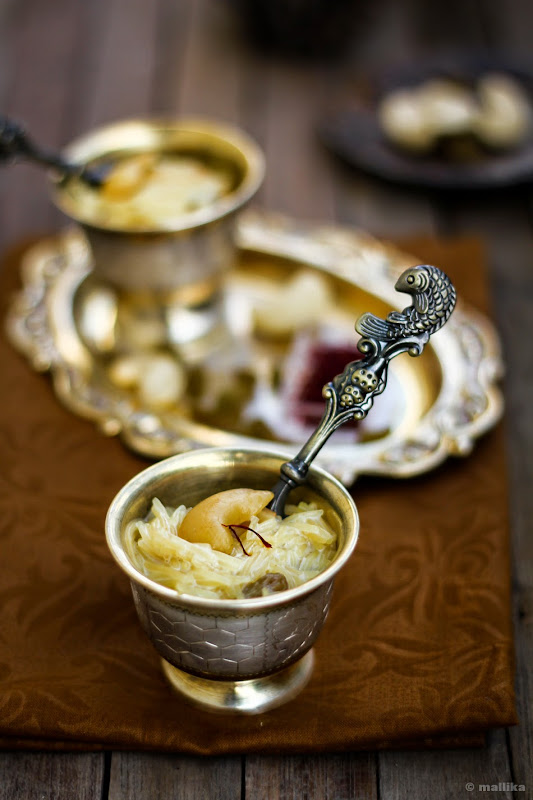
To say, that wasn’t the first time I had semiya kheer or shavige payasa, since we’ve grown up eating them regularly at home, to an extent one could simply abhor them even by the word of it. In ceremonies, at weddings, to offer guests or to enrich simple Sunday lunches. Shavige payasa made a hushed, humble manifestation between chirpy talks, deepened family bonding times, boosted celebrations or even merely uplifted spirits. So you’ll know there are several memories etched over bowls of this kheer or payasa, or whatever you choose to call which makes this dish unforgettable. There are cheerful moments of frolic and laughter we’ve breathed with our family and friends over meals that ended with this kheer. Those tiny blissful moments of celebrations made by mom on topping the class exams or lugging the first swim, a medal won at a school competition or dad’s promotions, we’ve reveled all those moments of simple pleasures with this kheer. That ceremonial food I would love to relish on endless occasions, sitting obverse the traditional banana leaf in long rows, awaiting patiently for the first dollop of the delicious payasa to be served on the designated bottom left corner of the leaf, and as it trickled down, saving the part of it by carefully lifting the edges of the leaf and licking it off the first thing the moment we chorused Hara Hara Mahadeva, Goooovinda! Those simple joys filled with nostalgia and memories that makes every little mouthful of this payasa utterly blissful.


But the fact is that vermicelli kheer is so damn easy to make, that it’s hardly any effort and can be whipped up in minutes on demand to celebrate any occasion and that’s what makes this dessert so special. Be it a celebration, an occasion, or drop of the hat guests visiting you or no-clue-dessert-on-the-whim, Shavige Payasa or Vermicelli Pudding is just the right kind of dessert you would fall back upon. If you are an Indian, then this probably is one of those first desserts you learn by heart, by instincts and not by lessons imparted by the older generations.

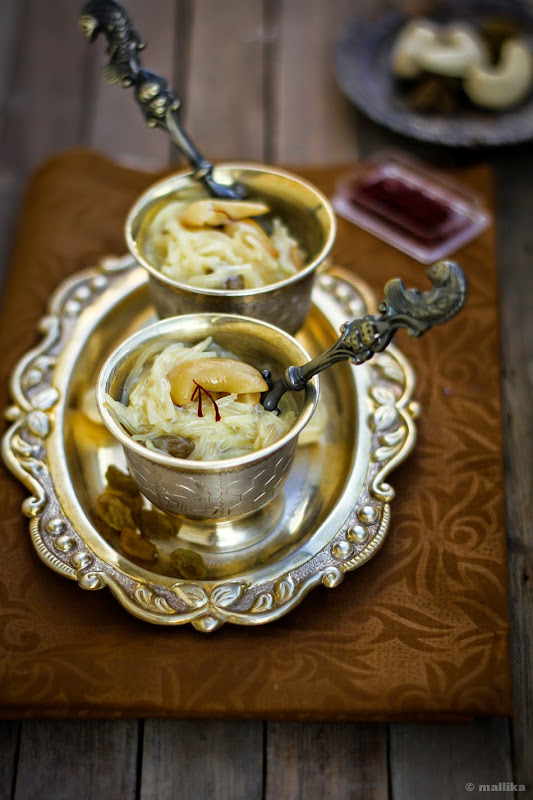
And a well-made vermicelli pudding is too delicious to ignore. It’s means subtly creamy, marginally condensed, not cloying sweet, with a touch of ochre goodness from saffron and earthy affection from cardamom that make up a bowl of deliciously perfect kheer. And those generous helpings of ghee-fried raisins and cashewnuts will only embellish this bowl of divine goodness. So if you are feeling lonely today or you just want to celebrate, conjure up your memories with this bowl of kheer.


Seviya Kheer / Shavige Payasa / Vermicelli Pudding

INGREDIENTS

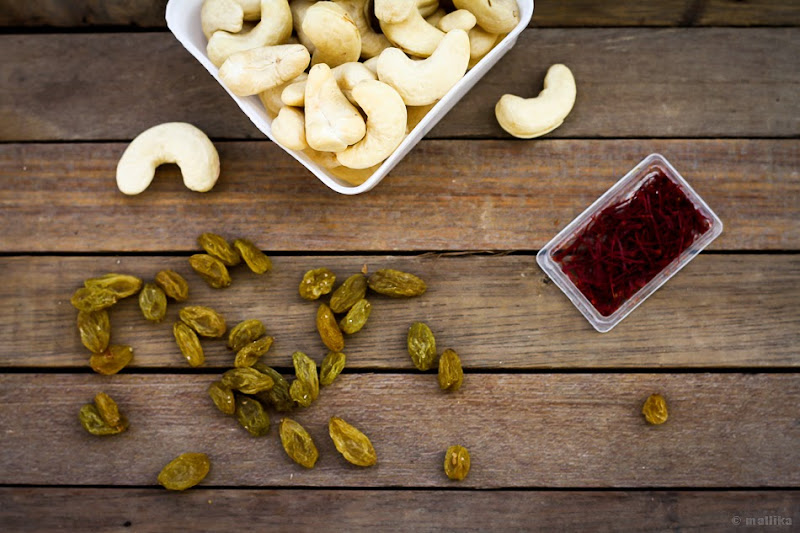
1 cup Vermicelli / Shavige, pre-roasted or lightly roasted to golden brown
3 cups Milk
2 tbsp. Milk powder, optional
3/4 cup Sugar
A generous pinch of Cardamom Powder
1 tbsp. Cashew nuts
1 tbsp. Raisins
1 tbsp. Ghee
4-6 strands Saffron strands dissolved in a tbsp. of warm milk

DIRECTIONS:

Heat milk in a pot till just warm. Dissolve the milk powder in it and bring it to a boil. Reduce the flame and add in roasted vermicelli / seviya to the milk and stir well. Stir gently and allow the seviya to cook through. When its al dente, add sugar to taste and cook further till the vermicelli is just soft. Do not overcook as it may end up being too mushy. Pour the saffron strands along with its milk, bring to boil and switch off the flame. Add fresh cardamom powder and stir well.

In a separate pan, fry the cashew nuts & raisins in ghee till cashews turn golden brown and the raisins begin to swell. Pour the fried dry fruits along with ghee to the prepared payasa / kheer. Serve the payasa / kheer hot, warm or cold.

Notes:

* Use the thicker variety of vermicelli, like MTR or Bambino since it holds shape after cooking.
* Pre-roasting is a must, else you will end up with a clumped, sticky pudding which is not very pleasing and palatable.
* I always have a stock of milk powder in my pantry, hence I have used it in this recipe. Milk powder is a cheat version to avoid slaving over for the milk to condense. Though using diluted condensed milk here will also work, milk powder does the same job equally well.
* Milk powder / Condensed milk is optional and gives the kheer a richer, creamier taste, though traditionally it’s not used and you may skip it altogether by using only plain full fat milk.

Rava Idli with Vegetable Sagu

How to make Rava Idli with Vegetable Sagu | Vegetable Sagu Recipe
Traversing through my old posts recently, which in a way I don’t do too often, strangely it felt odd for me to read of what I had written. Some made me laugh, some made me travel down the memory lane, some errors I fixed, some I felt proud of, I suppose it’s an anomalous sensation to read your own stuff. Some photographs made me think I should change, like the Marshmallows and S’mores, especially the ones I shot at night. Then as I dug deeper to my old, unheeded posts of 2009s, I thought they needed a makeover. Maybe sometime in future, when I recreate the same recipe and shoot again, I shall update them here. Or probably I’ll leave them that way and they’ll remind me how much I have evolved over the years in blogging.

You know I should hold on to penning down too much. Over the past couple of weeks, my posts, the write ups, have been spanning too long. I promise it’s not intentional. I like to write, to put my thoughts in words and do hope you enjoy reading them as much I love sharing my thoughts on food and memories with you.

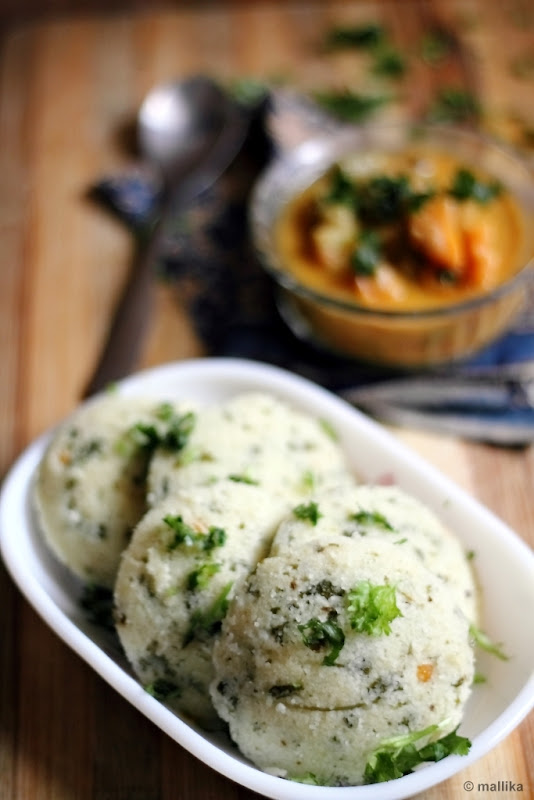
Rava Idli


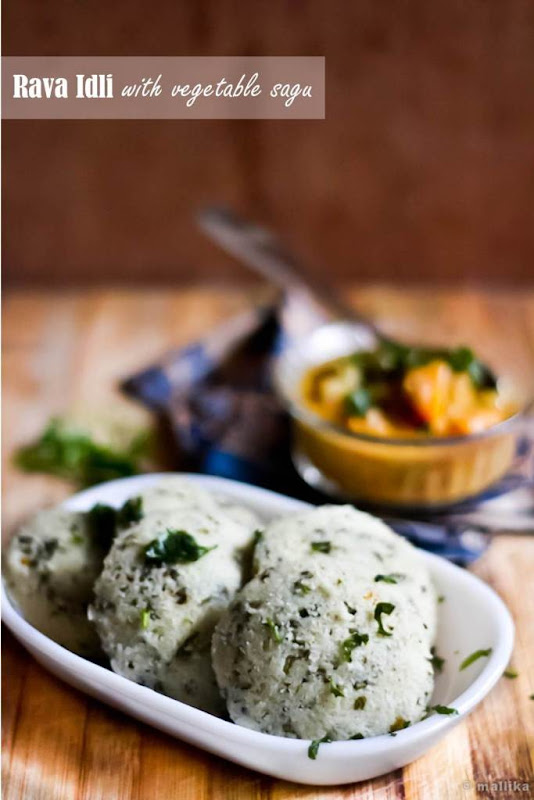
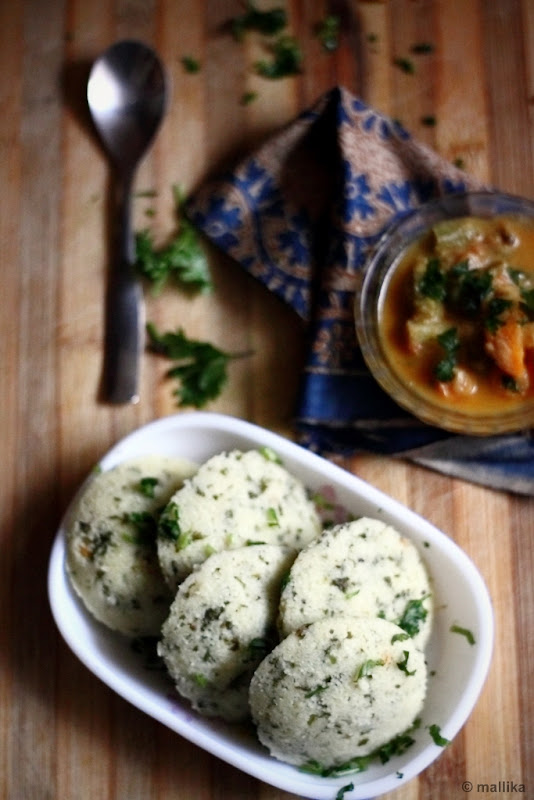
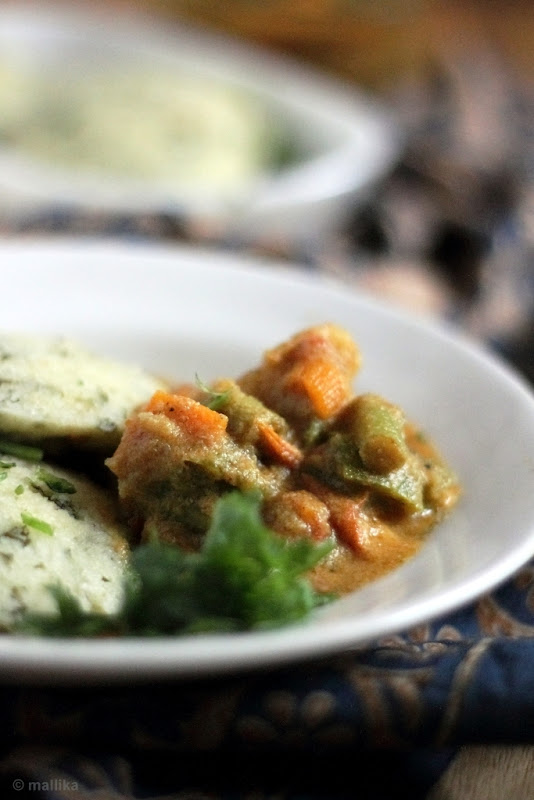
Having said that, I promise to keep this one short and savoury. Basically a spiced, savoury, breakfast semolina cake. This Rava Idli, is a common Karnataka breakfast dish and most loved by all of us at home. It repeats itself almost every week. Not the kinds we get at a restaurant, that’s dense, heavy and feels stodgy with one slice, but instant, light and the kinds you want to indulge in more than just one. Pair it with chutney or serve this with vegetable sagu like it’s done traditionally, this one will send you taste buds whirring for more. Whoosh, you can’t help but love it!


Rava Idli

1 cup regular yogurt (not thick, Greek yogurt kinds)
1 cup semolina (sooji rava)
2 tbsp. oil
1 tsp. mustard seeds
1-2 green chillies
1 sprig curry leaves
1 tsp. Channa dal
1 tbsp. broken cashew nuts
1 tsp. baking soda (or an unflavoured fruit salt, like Eno)
Salt to taste

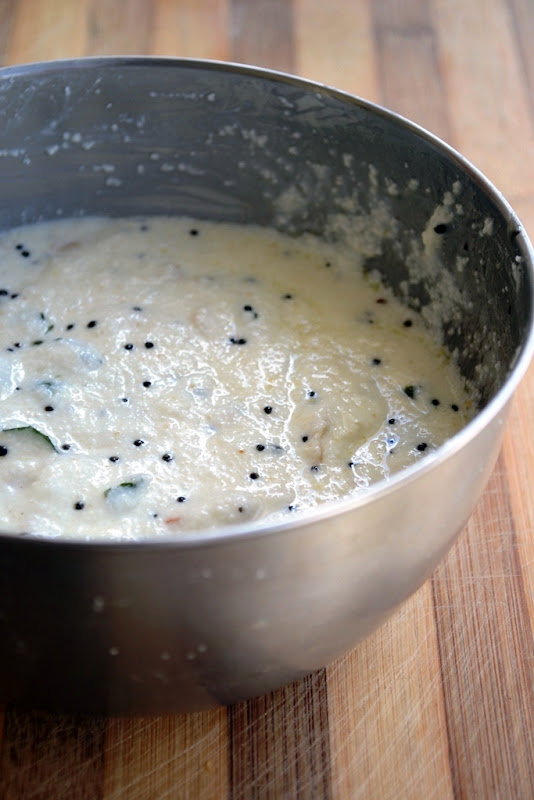
Mix a cup of semolina in cup yogurt and set aside for 10 minutes. If using thick store-bought yogurt, then thin it down by adding water. I've used regular skimmed milk homemade yogurt here. While the batter is resting, prepare the tadka. Heat the oil in a small frying pan. Add in the mustard seeds, channa dal, cashew nuts, curry leaves and heat till the mustard seeds begin to splutter. Turn off the flame and add this to the semolina, yogurt mixture. Whisk well. Add chopped green chillies and salt to taste. Finally add in the baking soda (or a sachet of fruit salt, if using), give the entire batter a quick, good whisk. The batter should be thick, similar to idli or cake batter. Transfer the batter to an oiled cake tin. If you have idli moulds, its best to use them. However you don’t own idli moulds, use regular cake tin for this purpose.

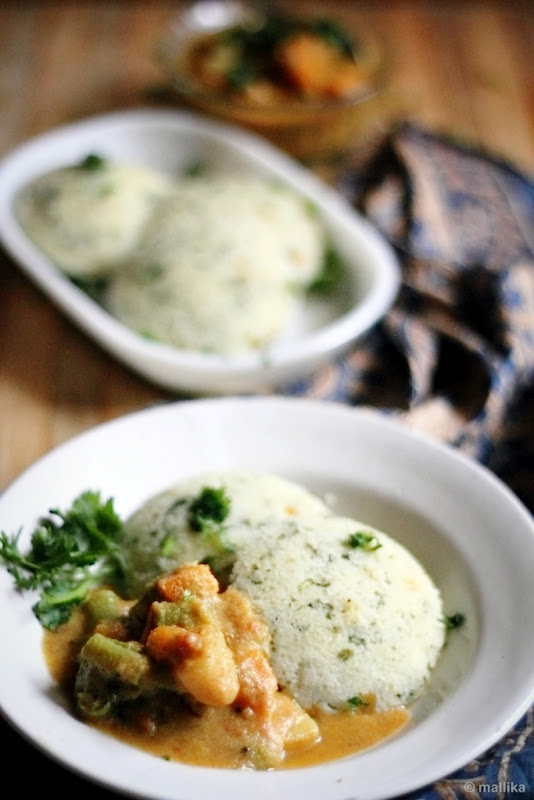
Heat a steamer / rice cooker. Place these moulds in the steamer and cook for 15-20 mins. Alternatively you can microwave it on high power for 4-5 minutes, till skewer inserted comes out clean. Slice and serve hot with any chutney of your choice or with vegetable sagu as available commonly in restaurants.


Mixed Vegetable Sagu

Mixed vegetable sagu is a popular Karnataka dish, typically served in Bangalore restaurants. It’s spicy and goes well with puris, dosas, aappam, and even rice. For best results, ensure that the vegetables are cooked just right – they should neither be crunchy nor too mushy, just the right bite.

INGREDIENTS

For The Masala Paste

2 to 3 green chillies, roughly chopped
4-5 peppercorns
2 tsp. coriander powder
1/2 tsp. cumin seeds
1/2” stick cinnamon
2 cloves
3-4 garlic cloves (optional)
4 tbsp. freshly grated coconut
1 handful of cilantro

Other Ingredients

1 tbsp. oil
1 tsp. mustard seeds
A pinch of asafoetida
A sprig of curry leaves
1 large onions, finely chopped
2 cups chopped mixed vegetables (potato, carrots, beans, capsicum, cauliflower green peas)
Salt to taste

DIRECTIONS

To make the masala paste, grind all the ingredients mentioned under masala, adding little water to a thick, fine paste. Keep aside.

Next, heat oil in a wide mouthed frying pan and add the mustard seeds. When the seeds begin to splutter, add asafoetida and torn curry leaves, and sauté well on a medium flame. Add the onions and sauté on a medium flame, while stirring continuously till they turn translucent. Add the mixed vegetables, salt and 1¼ cups of water, mix well and cover and cook on a medium flame for 12 to 15 minutes till the vegetables are tender, stirring in between. Add the prepared masala paste, mix gently and simmer for another 5 minutes. Serve hot with Rava Idli.